+86-15829664021
liangma0318@gmail.com
- All
- Product Name
- Product Keyword
- Product Model
- Product Summary
- Product Description
- Multi Field Search


Views: 0 Author: Site Editor Publish Time: 2026-08-27 Origin: Site
Drilling in coal seams presents unique operational challenges. Coal is highly friable. You also face unpredictable seam undulations constantly. Furthermore, strict requirements demand precise wellbore placement to maximize extraction efficiency. Operators must decide between investing in real-time Logging-While-Drilling (LWD) technologies or relying on traditional, post-drilling wireline logging. Misalignment between your chosen technology and the actual geological realities often leads to severe consequences. You might experience collapsed boreholes, lose expensive tools, or suffer poor geosteering outcomes. You simply cannot afford blind drilling. This guide provides an evidence-based comparison of azimuthal LWD and post-drilling gamma evaluation. We designed this resource specifically to help technical buyers and drilling engineers. You will discover how to select the most reliable and operationally sound approach for coal seam exploration and extraction.
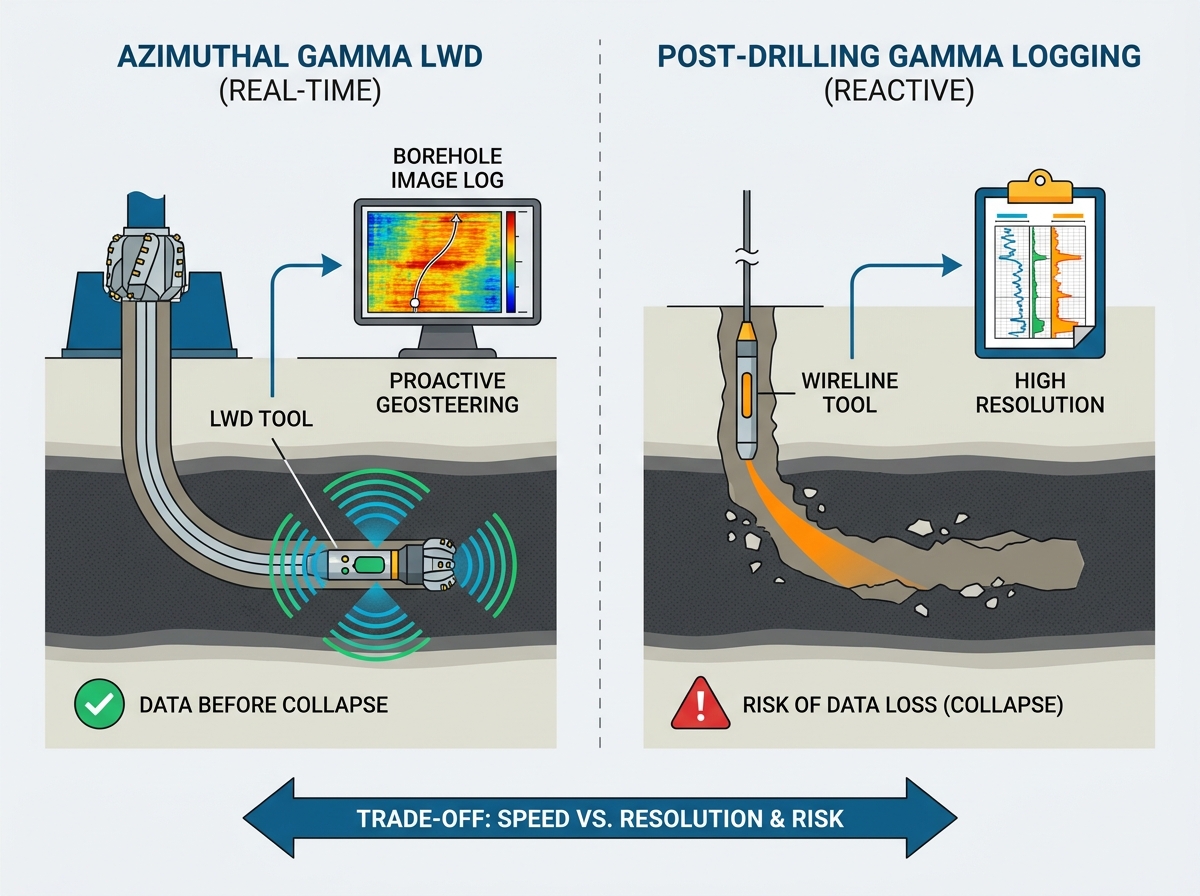
Real-Time Geosteering: Azimuthal gamma logging tools allow for proactive wellbore adjustments, keeping the bit within the coal seam "sweet spot" and avoiding costly roof or floor exits.
Borehole Stability Risks: Post-drilling logging carries a high risk of data loss if the coal seam collapses before the logging string can be deployed.
Cost vs. Risk Dilemma: While traditional wireline tools are cheaper to replace if lost, LWD mitigates the higher-probability risk of failing to log the well entirely.
Data Resolution: Post-drilling wireline generally offers higher vertical resolution and a quieter logging environment, making it ideal for stable, vertical pilot holes.
Coal exhibits extreme mechanical weakness. Natural fracture networks, known as cleats, compromise its structural integrity fundamentally. It easily washes out during active drilling operations. Sudden seam dips or geological faults occur frequently. These unpredictable elements destabilize the wellbore rapidly. You often face situations where the roof or floor rock collapses into the hole. This creates severe navigational hazards. Water invasion into the cleats exacerbates this instability. The coal begins to swell and spall almost immediately.
Exiting the coal seam hurts your drilling operation significantly. We call this "flying blind." It damages the drill bit when it strikes harder roof or floor rock. You also introduce massive non-productive time (NPT). The crew must stop drilling, assess the situation, and steer back into the target zone. For Coal Bed Methane (CBM) and Coal Seam Gas (CSG) projects, out-of-seam drilling directly reduces the productive length of the well. Less coal exposure means lower gas production rates over the lifespan of the asset.
To evaluate any logging solution in coal, we measure success against three strict criteria:
Lithological Contrast: The tool must distinguish coal from shale or sandstone instantly.
Shock Survivability: The internal electronics must withstand massive downhole vibrations.
Timely Data Delivery: The system must capture petrophysical data before the borehole degrades.
Modern azimuthal gamma logging tools use directionally focused gamma-ray detectors. They map "up" versus "down" radioactivity levels precisely. The detectors divide the borehole into discrete azimuthal sectors. As the drill string rotates at high speeds, they bin the gamma counts accordingly. This process creates a 360-degree real-time borehole image. This dynamic imaging provides an instant picture of the surrounding geology. You see exactly where the coal boundary lies relative to the drill bit.
You can translate early-warning structural dip calculations into immediate trajectory corrections. This represents true proactive geosteering. You keep the drill bit securely within the sweet spot. If the tool detects rising gamma radiation from the roof, you know shale is approaching. You simply steer downwards to remain in the clean coal. This continuous feedback loop prevents disastrous exits from the productive zone.
This approach offers the critical "Log-Before-Collapse" factor. You secure essential petrophysical data instantly as the bit cuts the rock. You eliminate the risk of losing data to reactive coal swelling. Wellbore collapse no longer destroys your logging program.
The real-time data capture provides several operational guarantees:
Immediate capture of formation properties just inches behind the bit.
Elimination of blind spots caused by sudden fault displacements.
Protection against complete data loss if the formation caves in unexpectedly.
However, you do face certain operational hurdles. High upfront daily rental costs exist for LWD equipment. You also face strict requirements for telemetry bandwidth. Mud-pulse or electromagnetic telemetry systems must transmit rich image data to the surface efficiently. Deep wells or highly compressible drilling fluids often complicate this data transmission process.
You deploy standard borehole gamma logging instruments via wireline or drill-pipe conveyance. You do this only after reaching the final target depth (TD). The drilling assembly comes out of the hole first. Then, the logging crew lowers the sensitive sensors into the open wellbore. Wireline logging utilizes a robust armored cable. This cable provides both physical support and high-speed electrical telemetry.
You operate in a quiet, non-drilling environment. Low vibration allows for much slower logging speeds. This controlled environment yields statistically superior data. Gamma emissions happen randomly. Longer exposure times at a specific depth yield a higher count rate. This reduces statistical noise significantly. You capture high-resolution static measurements. These clear logs prove invaluable for precise geological modeling and rigorous reserve estimation.
Tool replacement costs remain significantly lower compared to complex LWD assemblies. If you lose a wireline tool in a collapsing coal hole, the financial hit feels manageable. A lost-in-hole (LIH) LWD suite creates a massive financial burden. Wireline offers a highly conservative risk profile regarding equipment loss. Operators often prefer this method in wildcat wells where collapse risks remain completely unknown.
Despite these strengths, wireline remains strictly a reactive measurement. It tells you where you drilled, not where you should drill. It cannot assist in geosteering long horizontal sections. Furthermore, it remains highly vulnerable to inaccessible wellbores. If the friable coal collapses before the wireline descends, you lose the hole entirely. You also lose the opportunity to gather any form of data.
We must evaluate these technologies based on their specific application and desired operational outcomes. Horizontal and directional wells demand proactive systems. LWD azimuthal gamma is practically mandatory for staying in-zone over long laterals. The continuous real-time feedback prevents disastrous out-of-seam excursions. Conversely, vertical pilot or stratigraphic holes present entirely different requirements. Post-drilling wireline remains the industry standard here. It provides high-accuracy resource estimation where active steering is not required.
We must carefully compare the upfront deployment effort of LWD against the hidden logistical burdens of post-drilling. Wireline requires extra rig time dedicated solely to logging runs. You often need precautionary wiper trips to clear debris before the tools can descend safely. Furthermore, you must calculate the operational impact of missed pay zones if a blind well strays out of the coal seam. LWD requires more complex pre-job planning. However, it minimizes non-productive rig time by combining drilling and logging into one fluid operation.
Both data sets integrate smoothly into modern machine learning (ML) models. They enable automated coal identification algorithms. You can streamline quality assurance and quality control (QA/QC) workflows effectively. AI systems now process azimuthal images and static wireline logs side-by-side. They predict rock mechanics and optimize future well placements automatically.
Operational Comparison Matrix
Feature | Azimuthal LWD | Post-Drilling Wireline |
|---|---|---|
Deployment Timing | During active drilling | After reaching target depth |
Steering Capability | Proactive trajectory correction | None (Reactive measurement only) |
Data Resolution | Good (Subject to drilling vibration) | Excellent (High statistical precision) |
Borehole Collapse Risk | Low (Logs before degradation) | High (Vulnerable to reactive coal) |
Tool Replacement Risk | High financial impact if lost | Lower financial impact if lost |
You must select appropriate borehole exploration instruments carefully. You must match tool specifications to specific coal basin profiles. Evaluate API sensitivity limits thoroughly. Review maximum temperature ratings for deeper seams. Ensure the pressure ratings exceed the anticipated bottom-hole conditions. Not all tools perform equally in high-shock environments. You must review the tool's historical survivability metrics before signing a rental agreement.
LWD faces distinct telemetry limitations constantly. Transmitting rich azimuthal image data to the surface in real-time proves difficult. Signal attenuation occurs frequently in deep or heavily faulted seams. Electromagnetic telemetry sends low-frequency radio waves through the earth. Mud-pulse telemetry creates pressure waves inside the drill pipe. Mud-pulse struggles heavily in highly aerated drilling fluids. You must compress data heavily. This compression sometimes reduces image clarity at the surface, delaying critical geosteering decisions.
Standardized calibration checks remain completely necessary. You must calibrate azimuthal sensors accurately against known radioactive sources before deployment. You also need to manage environmental corrections carefully. Address drilling mud weight variations and hole size washouts properly. A severe washout creates tool standoff. This extra distance distorts the gamma ray readings if left uncorrected. Your QA/QC program must account for these environmental variables to ensure accurate lithology interpretation.
Azimuthal gamma LWD serves as more than just a logging method. It acts as an active drilling risk-management tool. It justifies its premium application in horizontal coal seam environments. In these specific areas, borehole stability remains poor. Steering accuracy dictates overall project success. The ability to react instantly to sudden seam dips saves millions in potential rework and lost production.
Post-drilling logging remains the most efficient choice for vertical appraisal wells. In these scenarios, data fidelity supersedes real-time navigation needs entirely. If you are drilling a straight hole solely to estimate reserves, the high-resolution data from wireline tools provides unmatched clarity.
Technical buyers should audit historical non-productive time rigorously. Evaluate past drilling reports. Calculate the exact hours lost to wiper trips or stuck pipe incidents. Analyze all delays related to borehole collapse and out-of-seam drilling events. Use this operational data to build a definitive business case for upgrading to advanced LWD systems where appropriate.
A: Gamma logs alone have distinct limitations. Coal presents distinctively low API readings. However, highly organic shales or clean sandstones also produce low gamma counts. Operators often need combined petrophysical responses. You should integrate density or resistivity measurements alongside gamma data. This combination helps reliably distinguish pure coal from low-gamma sandstones or complex organic shales during the drilling process.
A: Borehole washouts introduce a severe "standoff" effect. Increased distance between the sensor and the formation reduces azimuthal image contrast significantly. This makes determining structural dip much harder. However, the bulk gamma readings generally remain usable. You must apply robust environmental corrections for hole size and mud weight to salvage the data integrity effectively.
A: Running both is usually redundant in horizontal coal sections. However, complex appraisal wells sometimes mandate this dual approach. You might use LWD primarily for active steering and collision avoidance. Later, you run advanced wireline tools—such as sonic or high-resolution density instruments—to gather rigorous static data for official reserve certification and comprehensive geological modeling.