+86-15829664021
liangma0318@gmail.com
- All
- Product Name
- Product Keyword
- Product Model
- Product Summary
- Product Description
- Multi Field Search


Views: 0 Author: Site Editor Publish Time: 2026-09-20 Origin: Site
Procuring heavy equipment determines whether a job site stays on schedule or sinks into expensive delays. Site managers often face a tough choice when managing environmental fluids. You must choose between moving massive volumes of heavy sludge or applying intense kinetic force to clear hard blockages. Misprioritizing these fleet investments brings severe financial and operational risks.
Buying a high-pressure system for volume dewatering creates profound inefficiency. It also leads to immediate equipment damage as solid debris destroys sensitive internal components. Conversely, using a mud extraction unit for surface cleaning simply does not work. The output lacks the required jetting power to remove hardened scale. This article provides a hard-metric decision framework for fleet managers and site contractors.
We explore how to identify your critical-path bottleneck quickly. You will learn exactly which asset solves your immediate site challenges safely. By understanding these mechanical boundaries, you make smarter, more effective capital allocation decisions upfront.
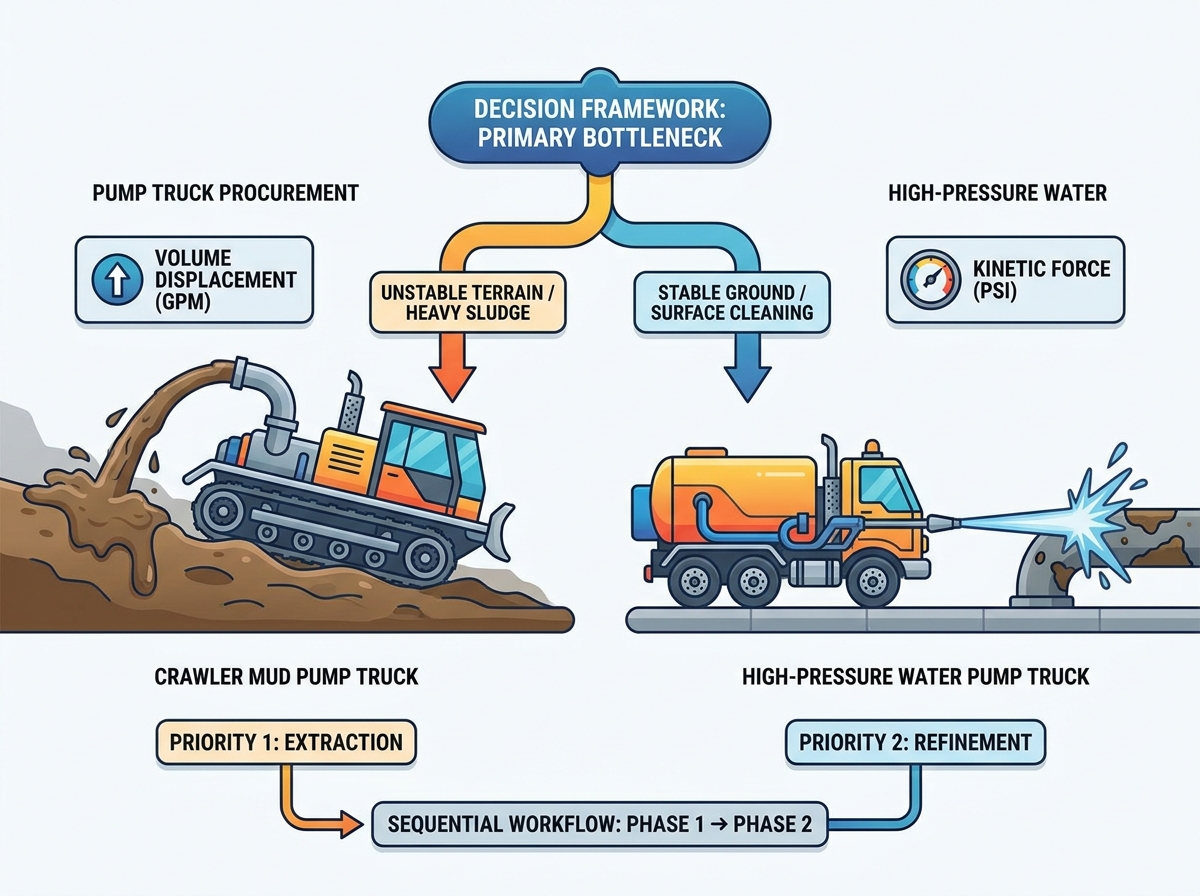
Prioritize crawler mud pump trucks when the critical path involves unstable terrain, high-viscosity fluids, or emergency large-scale dewatering.
Deploy high-pressure water pump trucks when project milestones depend on surface preparation, industrial cleaning, or pipeline clearing.
Evaluating horsepower, flow rate (GPM), and system requirements is secondary to defining the specific site terrain and material density.
Equipment sequencing dictates that material extraction (mud pumping) almost always precedes site refinement (high-pressure washing).
Evaluating your job site demands a strict material audit. You must determine the immediate operational threat before bringing heavy machinery to the site. Is the bottleneck standing water and dense sludge? Or is it structural fouling and hardened debris? These distinct problems require entirely different physical forces. Fleet managers must understand this core conflict.
The physics of the job dictate your equipment choice directly. Volume dewatering requires high-volume, low-pressure capability. You need to move thousands of gallons of heavy liquid quickly across long distances. Centrifugal forces excel in this scenario. Conversely, surface cleaning requires low-volume, high-pressure characteristics. You rely on sheer kinetic velocity to blast away stubborn deposits. Plunger pump mechanisms generate this necessary sheer force.
Misaligning these capabilities triggers severe financial impacts. Deploying a high-pressure system for volume dewatering wastes fuel. It consumes excessive time. It also risks catastrophic pump failure from ingesting solid debris. High-pressure units demand perfectly clean water to survive. Using a mud extraction unit to clean fouled pipelines proves equally ineffective. The machine simply lacks the focused pressure required to dislodge hardened materials. Managers must match the machine's physics to the specific material bottleneck. A poor choice guarantees expensive project delays.
Terrain adaptability remains the biggest factor for heavy extraction duties. A tracked undercarriage proves non-negotiable for harsh environments. Wheeled vehicles quickly sink in disaster-recovery zones. They become hopelessly stranded in off-road mud pits. Tracked machines distribute their tremendous weight evenly across soft ground. This design prevents severe rutting and allows autonomous positioning directly at the water's edge.
You must evaluate your site's solids handling limits thoroughly. Bentonite, drilling fluids, and heavy construction slurry destroy standard clear-water pumps. Specialized heavy-duty mud systems handle high-viscosity materials safely. They feature robust, wide-channel impellers. These specialized components easily pass large rocks and debris without jamming.
Engineers rely on these units for specific demanding environments:
Deep foundation excavations requiring continuous groundwater control.
Post-flood disaster recovery zones containing heavy, saturated silt deposits.
Mining operations extracting dense mineral slurries.
Horizontal directional drilling (HDD) sites managing thick bentonite returns.
For rapid flood control and deep foundation trenching, you need massive fluid displacement. Integrating large-flow mud pump trucks into your ecosystem scales the operation effectively. These units move tremendous volumes of heavy slurry per hour. They clear large containment basins in fractions of the usual time.
Success relies on proven, continuous duty cycles. A reliable unit maintains high GPM (Gallons Per Minute) extraction rates constantly. It must resist clogging during continuous 24-hour shifts. Operators count on crawler mud pump trucks to establish basic site access. They complete the critical foundational work before any other construction begins.
Some project milestones depend entirely on precision cleaning. Surface preparation and pipe clearing demand intense targeted energy. Here, kinetic force overtakes volume displacement priorities. Operators frequently deploy high-pressure water pump trucks for delicate hydro-excavation tasks. This method safely uncovers buried utilities without cutting active power lines. Municipal pipe jetting and heavy machinery decontamination also require these highly specialized units.
In these applications, the PSI over GPM rule governs success. Operational efficiency relies on maximum pressure capability. Precise nozzle configurations matter significantly more than sheer fluid volume. High PSI levels blast away stubborn concrete splatter. They sheer through thick tree root intrusions inside sewer lines. A massive volume of water at low pressure simply bounces off these hard obstructions.
However, buyers must recognize strict infrastructure dependencies before purchasing. These units possess specific operational requirements:
Stable Ground Conditions: Most high-pressure units utilize standard wheeled chassis designs. They require stable, compacted ground or paved roads for safe staging.
Clean Water Supply: High-pressure operations demand a reliable clean water source. Operators must secure dedicated hydrant access. Alternatively, they must utilize massive onboard holding tanks.
Debris Management: The blasting process creates a secondary slurry. Teams often need auxiliary vacuum trucks to remove the resulting wastewater immediately.
Pulling dirty site water destroys sensitive high-pressure plunger pumps instantly. Fine sand bypasses basic inlet filters. It quickly scores the ceramic plungers and blows out internal packings. Therefore, clear water staging remains a non-negotiable requirement for these assets.
Procurement teams must align power specifications with site realities. You need to balance engine horsepower against your required flow rates. Pump architecture plays a crucial role in this decision. Centrifugal designs excel at moving heavy mud volumes. They utilize a spinning impeller to create a pressure differential. Positive displacement pumps dominate high-pressure water applications. They force exact volumes of water through tiny orifices to generate extreme velocity.
Deployment logistics strongly influence daily operational speed. A tracked unit offers autonomous, self-propelled mobility. It navigates harsh terrain without external towing assistance. Operators simply drive it off the transport trailer directly into the mud. Conversely, standard water pump configurations often involve complex trailer setups. You must manage heavy towing vehicles. You face rigid placement limitations on unimproved sites.
Financial planning requires a close look at initial capital expenditure versus utilization rates. Calculating your return on investment depends heavily on job sequencing. You must evaluate the duration of each project phase. You might purchase a crawler unit for Phase 1 dewatering tasks. Subcontracting the high-pressure cleaning for Phase 3 could then maximize your capital efficiency. Evaluate the long-term frequency of each specific task across your entire project portfolio.
Performance and Procurement Differentiators
Feature Matrix | Crawler Mud Pump Unit | High-Pressure Water Unit |
|---|---|---|
Primary Function | Volume displacement and slurry removal | Kinetic surface cleaning and unblocking |
Optimal Terrain | Soft, muddy, unpaved, steep inclines | Compacted earth, paved roads, stable staging |
Pump Architecture | Heavy-duty centrifugal design | Positive displacement (plunger) design |
Fluid Requirement | Tolerates high solids, rocks, and debris | Requires highly filtered, clean water only |
Key Metric | GPM (Gallons Per Minute) | PSI (Pounds per Square Inch) |
Fielding this equipment exposes teams to unique implementation risks. Operator skill gaps often cause immediate project delays. Operating a crawler requires specific heavy equipment training. Operators must understand track tensioning protocols perfectly. They must calculate ground bearing pressure carefully before entering marshlands. Navigating steep, slippery slopes requires extensive hands-on experience to avoid rollovers.
High-pressure systems demand highly specialized pump technicians. These operators must master complex nozzle selection charts. They monitor the system constantly to prevent catastrophic cavitation. Proper pressure regulation prevents blown hydraulic lines and damaged site infrastructure.
Maintenance traps vary wildly between the two platforms. Mitigating abrasive wear consumes maintenance time for mud extraction systems. High-solids slurry constantly degrades impellers. It erodes the pump volutes quickly. Teams must perform frequent internal clearance checks. This regular maintenance maintains the necessary suction lift.
High-pressure units present completely different physical vulnerabilities. Maintenance teams focus entirely on preventing cavitation. They work diligently to avoid sudden seal blowouts. Filter blockages pose a constant threat on dusty construction sites. If operators draw water from compromised municipal sources, tiny particulates destroy the internal valves rapidly.
Site safety and compliance add another layer of complexity. Active sites must strictly manage dirty water runoff. Environmental regulations enforce heavy fines for improper sediment discharge. High-pressure operations introduce severe safety protocols regarding hose management. A ruptured high-pressure line causes catastrophic physical injury. Site managers must enforce rigid exclusion zones during active jetting operations. Noise compliance also forces teams to monitor engine decibel output near residential zones.
Site fluid management follows a strict operational sequence. The sequential rule of thumb provides clear guidance. Mud extraction and dewatering typically form the foundational phase of any project. Without clearing the bulk water and sludge, further construction simply cannot proceed. Therefore, tracked mud extraction units usually demand first-priority capital allocation. They establish the dry groundwork. Only after stabilizing the site do refinement and cleaning tasks begin.
To make the most effective procurement decision, follow these actionable next steps:
Conduct a comprehensive site material audit to classify the primary fluid density accurately.
Evaluate your terrain to determine if a wheeled chassis will survive the environment or sink immediately.
Define your exact operational goal clearly. Are you moving massive volumes or applying pinpoint kinetic force?
Review required GPM and PSI specifications carefully. Compare these metrics against manufacturer performance curves before requesting formal quotes.
By clearly defining your exact bottleneck first, you ensure your equipment solves the problem efficiently. Proper sequencing guarantees an efficient, safe, and profitable job site.
A: No. Modifying these units proves highly inefficient and mechanically risky. Large-flow units utilize centrifugal pump architectures designed for volume, not pressure. High-pressure cleaning requires positive displacement plunger pumps. Attempting to restrict a centrifugal pump's outflow to generate high pressure causes severe internal turbulence. It destroys the impeller and overheats the fluid rapidly.
A: Crawler maintenance focuses heavily on the undercarriage. Technicians must regularly adjust track tension, grease idler wheels, and clear hardened mud from the sprockets. Track replacement represents a major periodic expense. Wheeled pump trucks require standard commercial chassis upkeep, including tire pressure management and axle alignment. The wheeled chassis is cheaper to maintain but lacks off-road durability.
A: Soft, unpaved, or high-grade incline environments make standard trailer setups hazardous. Heavy water pump trailers easily sink in mud or jackknife on wet slopes. Tow-weight limits restrict mobility on soft ground. For these rough conditions, self-propelled crawlers eliminate the need for heavy tow vehicles. They navigate grades safely without external hauling assistance.