+86-15829664021
liangma0318@gmail.com
- All
- Product Name
- Product Keyword
- Product Model
- Product Summary
- Product Description
- Multi Field Search


Views: 0 Author: Site Editor Publish Time: 2026-07-08 Origin: Site
Procurement in the horizontal directional drilling (HDD) industry carries massive financial stakes. You invest hundreds of thousands of dollars into heavy machinery expecting seamless performance and rapid project turnarounds. Every underground project depends entirely on the raw power, reliability, and precision of your chosen equipment.
However, selecting a directional drilling rig based solely on surface-level specifications often backfires. Misjudging actual machine capabilities leads to stalled bores, stuck product pipes, and blown project timelines. Furthermore, oversized equipment crushes profit margins through excessive transport requirements, heavy-haul permits, and inflated daily operating expenses.
We built this guide to provide a rigorous, evidence-based framework for evaluating core HDD specifications. You will learn exactly how to interpret torque, feed, pullback, and drilling depth realistically. Ultimately, contractors can use these practical insights to match machine capabilities to actual field realities, ensuring maximum profitability on every bore.
Pullback force is not absolute: Usable pullback is dictated by fluid flow, soil drag, and the weight of the product pipe.
Torque determines cutting efficiency: High torque is mandatory for large reamers and rocky conditions, but must be paired with adequate mud flow to clear cuttings.
Over-sizing hurts margins: Selecting a directional drilling rig with excess capacity increases mobilization costs, fuel burn, and footprint requirements.
Evaluate the holistic system: A rig’s theoretical drilling depth is irrelevant if the onboard pump capacity cannot maintain required annular pressure.
Procurement decisions directly dictate your project profitability. Buying the right machine requires strict discipline and a deep understanding of your typical job profile. A highly profitable machine operates at 70-80% of its maximum capacity for the majority of its utilization lifecycle. This operational sweet spot prevents you from overtaxing the system. It also ensures you avoid paying for massive hydraulic power you rarely use.
What happens when you under-specify your equipment? You face severe financial and operational risks. You significantly increase the likelihood of getting product pipe stuck mid-bore. When you exhaust your machine's pullback, you must excavate the drill head manually, costing thousands of dollars in delays. Constant max-load operation also accelerates wear on critical hydraulic components. Your pumps burn out faster, and your rotation motors degrade prematurely. Dense formations cause major project delays because operators lack the necessary power to push through hard ground and steer effectively.
Conversely, over-specifying carries hidden, but equally destructive, financial penalties. You face a much higher initial capital expenditure upfront. Logistical complexity skyrockets overnight. You might require expensive heavy-haul permits for transport. You often need larger trailers and specialized commercial drivers to move the equipment. Furthermore, physical footprint constraints severely limit your job bidding. Massive machines simply cannot fit into tight urban environments. They destroy residential lawns and block narrow city streets. By over-sizing your equipment, you actively shrink your potential market.
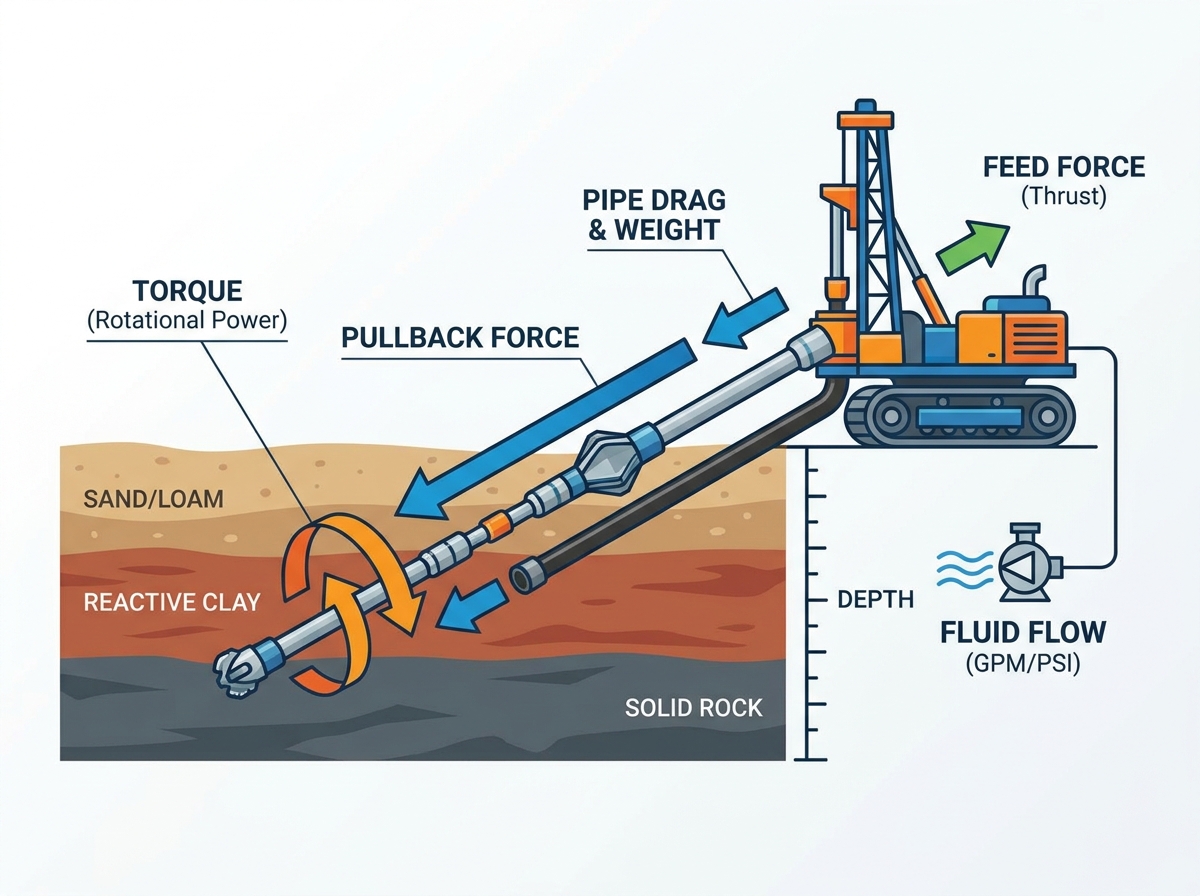
Directional Drilling Core Specifications Overview
Specification | Measurement Unit | Primary Function | Key Limitation Factor |
|---|---|---|---|
Torque | Foot-pounds (ft-lbs) | Rotates the drill string and reamer | Drill rod yield strength |
Pullback | Pounds (lbs) | Retrieves pipe through the borehole | Soil drag and pipe weight |
Feed (Thrust) | Pounds (lbs) | Pushes the pilot bit forward | Ground density and steering limits |
Drilling Depth | Feet / Meters | Defines maximum bore length | Fluid pump capacity and rod bend radius |
Definition: Torque represents the twisting force applied directly to the drill string. We measure it in foot-pounds (ft-lbs).
Evaluation Lens: Torque dictates your cutting efficiency. It determines the maximum size of the reamer you can turn. It also defines the machine's ability to cut through high-density soils like heavy clay, shale, and solid rock. If you lack torque, the reamer stalls, and you cannot enlarge the hole.
Assumption Check: High torque requires high-strength drill rods. Many contractors push maximum torque while ignoring rod limits. Exceeding rod makeup torque limits triggers catastrophic downhole failure. You twist the steel apart deep underground, forcing expensive retrieval operations.
Definition: Pullback is the pure hydraulic force used to pull the reamer and product pipe back through the bore path. We measure it in pounds (lbs).
Evaluation Lens: Your pullback must exceed the combined weight of the product pipe and the frictional drag of the specific soil type. You cannot rely on raw numbers alone. Industry standard dictates applying a strict 1.5x to 2x safety factor to your anticipated drag. This buffer protects you against sudden bore collapses or sticky clay layers.
Definition: Feed force provides the forward pressure applied to push the pilot bit through the ground.
Evaluation Lens: You need robust thrust for initial steering and penetrating hard ground. Without sufficient thrust, the bit deflects off rocks instead of cutting through them. In modern rack-and-pinion systems, thrust often closely matches pullback force because they utilize the same mechanical drive system for both directions.
Definition: This defines the maximum theoretical length and depth the rig can achieve under perfect conditions.
Evaluation Lens: This metric remains highly variable in the field. Actual distance is severely limited by your drill rod inventory. More importantly, the rod bending radius restricts your steering geometry. Theoretical depth means nothing if your pumps cannot maintain fluid returns over long distances. Rely on practical field limits, not marketing brochures.
To succeed, you must translate paper specifications into subsurface realities. Different ground conditions and product materials radically alter how your equipment performs.
Soil Type vs. Force Requirements:
Loam and Sand: These loose soils require lower torque for rotation. However, you need exceptionally high mud flow. Fluid maintains borehole integrity and prevents sand from collapsing. Your pullback force focuses primarily on overcoming the dead weight of the pipe itself.
Reactive Clay: Clay presents unique challenges. It requires moderate torque but specific fluid mixes. You must use proper polymers to prevent the clay from swelling. Swelling clay grips the product pipe like a vice. Therefore, clay environments demand exceptionally high pullback capacities to overcome severe friction drag.
Solid Rock: Hard rock demands maximum torque. You often require specialized mud motors. In these formations, thrust becomes a major limiting factor. Progressing the pilot bore requires immense forward pressure to keep the cutting teeth engaged.
Product Pipe Diameter to Rig Size Ratio:
You must establish baseline pullback requirements based on your most common installations. Pulling a 2-inch fiber optic conduit requires minimal force. Pulling a 24-inch water main creates massive drag and displacement challenges.
Material weight changes dynamically during installation. High-Density Polyethylene (HDPE) pipe naturally floats in dense drilling fluid. Steel pipe sinks heavily to the bottom of the bore. You must precisely factor in this wet weight during the pullback phase. It dramatically alters your required hydraulic force.
Specifications can lie by omission. If you only look at torque and pullback, you miss the critical support systems that actually keep the pipe moving.
Fluid pump capacity remains the most critical hidden risk. Evaluate the Gallons Per Minute (GPM) and Pounds per Square Inch (PSI) ratings carefully. A rig producing massive torque needs a high-volume pump to match. If you have low fluid volume, you fail on large-diameter bores. You cannot maintain sufficient annular velocity. When velocity drops, cuttings fall out of suspension. You cannot flush them out of the hole. The borehole packs off, pressure spikes, and your pipe gets permanently stuck.
Drill rod limitations also impose hard boundaries on your operations. Your rig’s maximum pullback and torque must strictly align with the yield strength of your selected drill rods. Furthermore, the minimum bend radius of the rods dictates your entry angle. It limits how fast you can drop to your required depth. Sharp steering corrections bend rods past their memory limit. This weakens the steel and significantly impacts your total achievable bore length.
Finally, jobsite footprint and transport logistics dictate your daily overhead. You must comply with local weight restrictions. Assess your entire transport setup carefully. Does the combined weight of the machine, trailer, and fluid system require a CDL (Commercial Driver’s License)? A CDL requirement fundamentally changes your operator hiring process. It increases payroll costs and regulatory compliance burdens. Transport logistics can easily ruin a project's profitability before the drill bit even touches the ground.
When you prepare to purchase, ignore the sales hype. Use a methodical, data-driven approach to match your future machine to your actual daily workload.
Audit Historical Job Data: Look back at your project history over the last 24 months. Calculate the 80th percentile of your typical bore lengths. Track your average pipe diameters and standard soil conditions. Buy equipment that easily handles this 80th percentile. You can always rent larger machines or subcontract out the rare 20% outlier jobs. This strategy preserves your capital.
Apply the Safety Factor: Never buy a machine that just barely meets your requirements. Calculate your maximum anticipated soil drag. Calculate your peak rotational loads. Multiply these figures by 1.5. This establishes your baseline minimums for torque and pullback. This safety factor provides a crucial buffer when you hit unexpected rocky patches or sticky clay lenses.
Evaluate Support Systems: The drill operates as part of a larger ecosystem. Inspect the mud mixing system carefully. Ensure the onboard or external fluid system scales perfectly with the machine's theoretical maximum bore size. A massive drill paired with a tiny mud reclaimer creates a severe bottleneck. Your fluid system must keep pace with your cutting speed.
Successful HDD procurement requires careful alignment between mechanical power and field realities. The most effective machine rarely boasts the highest raw numbers on a spec sheet. Instead, the best machine balances torque, pullback, and fluid capabilities seamlessly. These elements must perfectly match your core operational profile and transport capabilities.
We recommend prioritizing a balanced, holistic system over isolated peak specifications. Never buy based on pullback alone. Urge your procurement team to request real-world operational data. Demand a live demonstration in representative soil conditions before final sign-off. To explore reliable options tailored to your field needs, contact our experts regarding your next directional drilling rig. We can help you analyze your historical job data and configure a system that protects your profit margins.
A: Base your calculation on three core factors. First, determine the product pipe's wet weight. Second, calculate the specific soil drag coefficient for your ground conditions. Finally, add a 1.5x safety margin to the total. This formula ensures you maintain enough power to overcome unexpected subsurface friction without stalling the machine.
A: No. Lack of torque prevents you from opening the hole to the proper diameter. If the reamer cannot cut efficiently, cuttings build up immediately. This leads to a stuck pipe regardless of your total pullback capacity. Torque and pullback must always work together in a balanced ratio.
A: Fluid performs three critical downhole jobs. It clears cuttings out of the borehole. It cools the cutting bit. It stabilizes the hole walls against collapse. Without sufficient fluid flow, high torque and pullback merely create excessive downhole friction. This inevitably leads to equipment failure and stuck product pipes.
A: Not always. Theoretical depth assumes perfect ground conditions and perfectly straight paths. Actual achievable depth remains heavily limited by the drill rod's allowable bend radius. Frequent steering corrections reduce your effective reach. Always calculate distance based on realistic rod limitations rather than laboratory conditions.