+86-15829664021
liangma0318@gmail.com
- All
- Product Name
- Product Keyword
- Product Model
- Product Summary
- Product Description
- Multi Field Search


Views: 0 Author: Site Editor Publish Time: 2026-10-22 Origin: Site
Deploying advanced mining equipment demands massive capital expenditures. Post-deployment mechanical or software failures can quickly bleed operational budgets dry. A dangerous gap often exists between vendor specifications and operational reality. What works perfectly on the assembly line rarely survives the brutal conditions of a subterranean mine site. You must bridge this performance divide proactively. Structured Factory Acceptance Testing (FAT) and Site Acceptance Testing (SAT) act as non-negotiable risk mitigation tools. They secure your return on investment and ensure operator safety. By executing these frameworks, you align theoretical equipment performance with actual site capabilities. This guide explores how procurement teams and engineers can execute rigorous acceptance checks to keep production timelines on track. You will learn how to validate complex automation software, integrate new rigs seamlessly, and leverage independent experts to guarantee your next major equipment purchase performs exactly as promised.
FAT prevents expensive fixes: Catching software and mechanical integration errors at the OEM facility costs exponentially less than fixing them underground.
SAT validates real-world capability: Environmental factors (humidity, rock mechanics, network latency) require testing core features like automatic drill rod handling under actual mine conditions.
Independent verification is crucial: Utilizing specialized underground drilling technology services ensures testing standards remain objective and compliance-driven.
Many procurement teams rush equipment deployments to meet aggressive production schedules. They skip detailed acceptance phases. This oversight creates massive financial and safety risks. Deploying poorly vetted automated underground drilling rigs directly into active zones frequently leads to unexpected downtime. Sensitive collision avoidance sensors fail when exposed to harsh environments. Safety interlocks malfunction unexpectedly. Operators face extreme danger when autonomous systems do not respond correctly to manual overrides.
Before you even sign the purchase order, you must define strict success criteria. Engineering teams need to outline what acceptable performance looks like. It is never enough to trust a vendor brochure. You must document acceptable cycle times, strict fault tolerances, and remote connectivity metrics.
Maximum fault tolerance: Define the number of acceptable sensor drops per shift before a system requires maintenance.
Cycle time limits: Establish strict operational baselines for autonomous drilling cycles to ensure productivity goals remain attainable.
Connectivity minimums: Require specific bandwidth and latency thresholds for tele-remote operations.
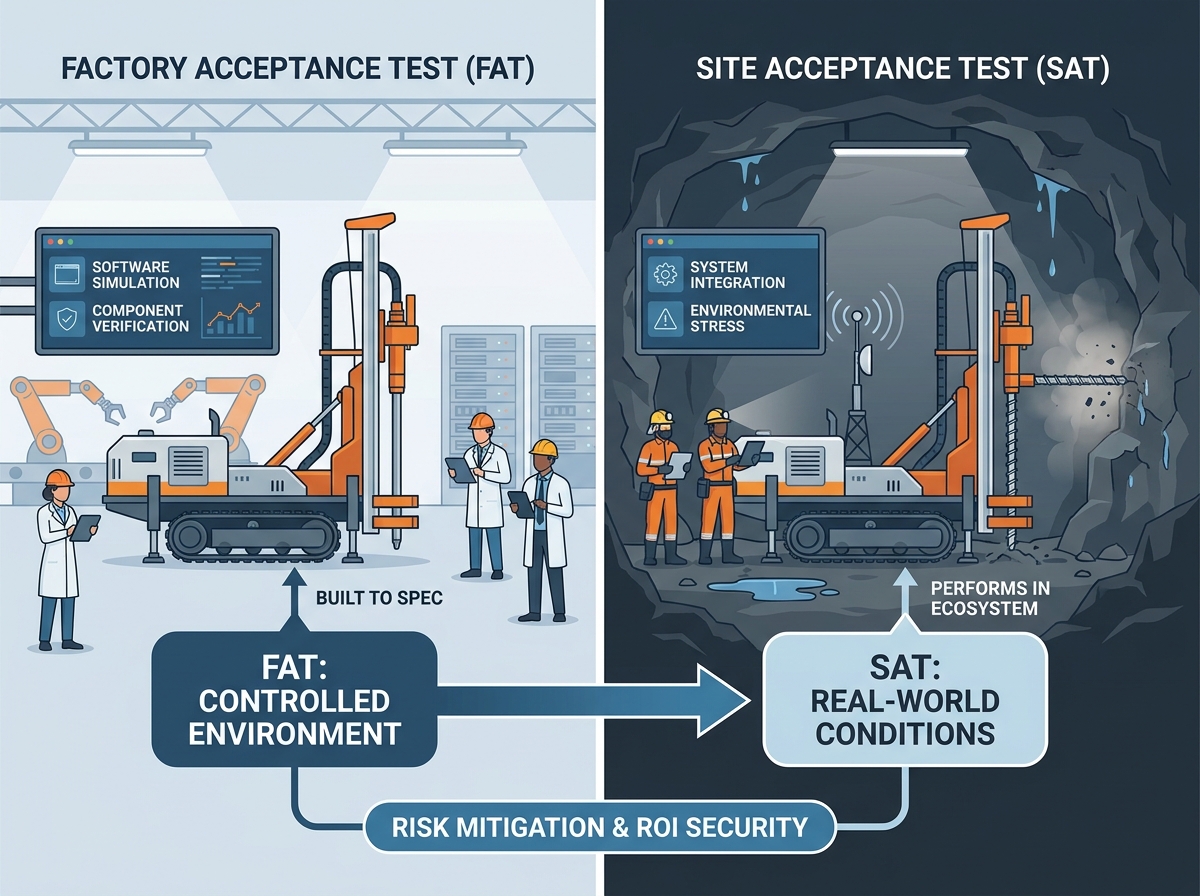
You must clearly distinguish between the two core testing phases. FAT verifies the equipment is built to exact manufacturing specifications. It proves the machine functions in a perfect, controlled environment. SAT verifies the equipment performs safely in your intended ecosystem. It proves the machine works in your specific, unpredictable mine environment.
Factory validation forms your first line of defense. Testing the rig at the manufacturer’s facility before shipping catches critical flaws early. You run these tests in a highly controlled environment. The factory floor provides perfect lighting, stable power grids, and zero environmental contamination.
We focus heavily on automation and software simulations during this phase. Teams must evaluate tele-remote functionality rigorously. Collision avoidance sensors require extensive physical obstruction tests. Emergency stop (E-stop) fail-safes must trigger instantly under simulated system overloads. Software bugs discovered here take minutes to patch. Finding them underground takes days.
Here is the standard FAT execution sequence:
Visual and Structural Inspection: Examine all weld joints, hydraulic hosing routes, and protective casing integrations.
Software Simulation Runs: Execute full operational cycles using virtual mine environments to test logic controllers.
Mechanical Dry Runs: Operate booms, feeds, and jacks without external rock resistance to ensure smooth articulation.
Safety Override Verification: Trigger E-stops during active automated sequences to guarantee instant shutdown.
A major component focus during FAT involves automatic drill rod handling systems. You must verify the precision, speed, and safety of these handlers under dry conditions. Engineers check for hydraulic fluid leaks during rapid cycling. They measure sensor alignment to ensure the grippers do not drop steel during rapid transitions.
Finally, teams must conduct thorough documentation and compliance reviews. Review vendor certifications closely. Verify material traceability for load-bearing components. Ensure everything aligns with baseline safety standards, including ISO and API guidelines for mining equipment. Missing paperwork at the factory often signals deeper manufacturing shortcuts.
Passing FAT does not guarantee SAT success. The implementation realities of a subterranean mine change everything. You introduce aggressive environmental variables immediately upon deployment. Thick abrasive dust chokes moving parts. Constant water ingress shorts exposed wiring. Extreme ambient temperatures cause hydraulic fluids to behave unpredictably. Uneven terrain wreaks havoc on leveling sensors.
System integration becomes the next massive hurdle. You must test the rig’s ability to communicate across the mine’s existing infrastructure. Perfect factory Wi-Fi means nothing below ground. Assess how the rig handles handovers between Wi-Fi, LTE, or underground 5G networks. Verify data flows smoothly into your existing Fleet Management Systems. Dropouts in telemetry data can paralyze remote operations.
You must aggressively stress test automation features. Re-evaluate automatic rod handling and autonomous drilling cycles in actual rock faces. Factory dry runs cannot simulate the vibrations caused by fracturing hard rock. Measure realistic penetration rates against geological data. Run bit-wear diagnostics to see if the automated feed pressure adjusts correctly.
Operator handoff marks the final phase of SAT. Assess the UI/UX of the control cabins. Determine the learning curve for your site personnel. Complex software interfaces often overwhelm operators transitioning from manual rigs. If operators cannot interpret the screen diagnostics quickly, overall productivity will plummet.
SAT Environmental Stress Matrix
Test Element | Factory Condition (FAT) | Site Condition (SAT) |
|---|---|---|
Sensor Calibration | Clean, well-lit, static environment | High dust, low visibility, heavy vibration |
Network Connectivity | Stable dedicated Ethernet/Wi-Fi | Fluctuating LTE/5G, node handoff delays |
Hydraulic Stress | No load, free movement | Maximum load against dense rock formations |
Thermal Regulation | Climate-controlled facility | High ambient heat, poor ventilation |
Procurement teams need practical evaluation dimensions to justify massive capital outputs. You must map automated features directly to productivity outcomes. A feature-rich brochure means nothing if it does not solve site-specific bottlenecks. Ask direct questions. Does the automated drilling cycle actually reduce shift changeover delays? Can tele-remote operation continue safely during blast clearance times?
Scalability and vendor agnosticism require deep evaluation. Determine if the rig’s software architecture allows future upgrades. Proprietary code can lock your mine into a closed vendor ecosystem. You want open-architecture systems. They allow integration with third-party analytics platforms seamlessly. Closed systems force you to rely entirely on the original manufacturer for every minor software tweak.
Security and compliance stand as absolute pillars during evaluation. Assess cybersecurity protocols for networked rigs carefully. Underground fleets now rely on interconnected operational technology networks. A single vulnerability in a remote control system could compromise the entire mine network. Ensure strict compliance with regional underground safety mandates. Governing bodies frequently update safety interlock requirements. Your procurement checklist must reflect the most current regional standards.
Procurement Evaluation Focus Areas
Category | Evaluation Focus | Desired Outcome |
|---|---|---|
Productivity | Shift changeover impact | Continuous drilling during operator transitions |
Software Architecture | API access and data export capabilities | Seamless integration with existing fleet management |
Cybersecurity | Encrypted telemetry and local override controls | Protection against unauthorized remote access |
Compliance | Adherence to local mining safety acts | Zero regulatory fines or safety shutdowns |
Relying solely on the original equipment manufacturer (OEM) for validation creates a massive conflict of interest. The OEM wants to ship the product quickly. They want to sign off on internal checklists and close the contract. Their internal FAT and SAT protocols naturally favor their own equipment design. This inherent bias often glosses over minor integration flaws.
Partnering with independent underground drilling technology services eliminates this conflict. Third-party experts bring standardized evaluation frameworks. They utilize specialized diagnostic tools designed to find faults, not ignore them. Independent validation ensures you receive unbiased reporting. They act as your technical advocate during disputes over equipment performance.
Shortlisting a validation partner requires careful consideration. Look for specific criteria when making your selection to ensure maximum leverage.
Brand Experience: Ensure they have proven experience testing the specific OEM brands you plan to purchase.
Geotechnical Knowledge: Verify they deeply understand your local geotechnical conditions and rock mechanics.
Negotiation Support: Select partners who offer post-SAT warranty negotiation support. They can use SAT failure data to demand mechanical retrofits before final payment.
These specialized services bridge the knowledge gap between your procurement team and the OEM engineering department. They hold manufacturers accountable to every promised specification.
Factory and site validation checks are not administrative checkboxes. They serve as foundational stages for operational readiness and mine safety. Skipping these rigorous protocols exposes your operation to devastating financial losses and unacceptable safety hazards. When you implement strict testing parameters, you guarantee the equipment matches your operational reality.
Here are the critical next steps for your operation:
Incorporate rigorous, independent validation requirements into all future procurement contracts.
Map every automated feature to a measurable productivity outcome before deployment.
Establish clear fault tolerance baselines during factory testing to prevent site-level failures.
Embrace third-party auditing to eliminate OEM bias during final site handover.
Do not leave your operational efficiency to chance. Download a comprehensive FAT/SAT checklist today. Schedule a consultation with a testing and commissioning specialist to safeguard your next equipment investment.
A: FAT confirms manufacturing specs at the factory; SAT confirms functional integration at the mine site. Factory checks ensure the build quality is flawless, while site checks ensure the machine survives your specific environmental challenges.
A: It varies by complexity. Generally, you should outline realistic timelines allocating 1-2 weeks for FAT. Plan for 2-4 weeks for a thorough SAT. Complex autonomous systems often require the full four weeks for integration testing.
A: This happens due to environmental introduction. Grit and moisture alter sensor feedback. Unlevel drilling planes disrupt mechanical alignment. The factory provides a perfect, static environment, whereas the mine introduces dynamic variables not present during FAT.