+86-15829664021
liangma0318@gmail.com
- All
- Product Name
- Product Keyword
- Product Model
- Product Summary
- Product Description
- Multi Field Search


Views: 0 Author: Site Editor Publish Time: 2026-10-30 Origin: Site
Moving heavy drilling equipment into constrained underground environments is often the highest-risk and most bottlenecked phase of a coring or production project. Navigating tight shafts and narrow drifts demands absolute precision. One miscalculation can halt operations for weeks.
Traditional unified rigs frequently require costly drift enlargements or complex dismantling. Tearing down these monolithic machines often compromises factory calibration. Reassembling them in dirty conditions introduces severe contamination risks.
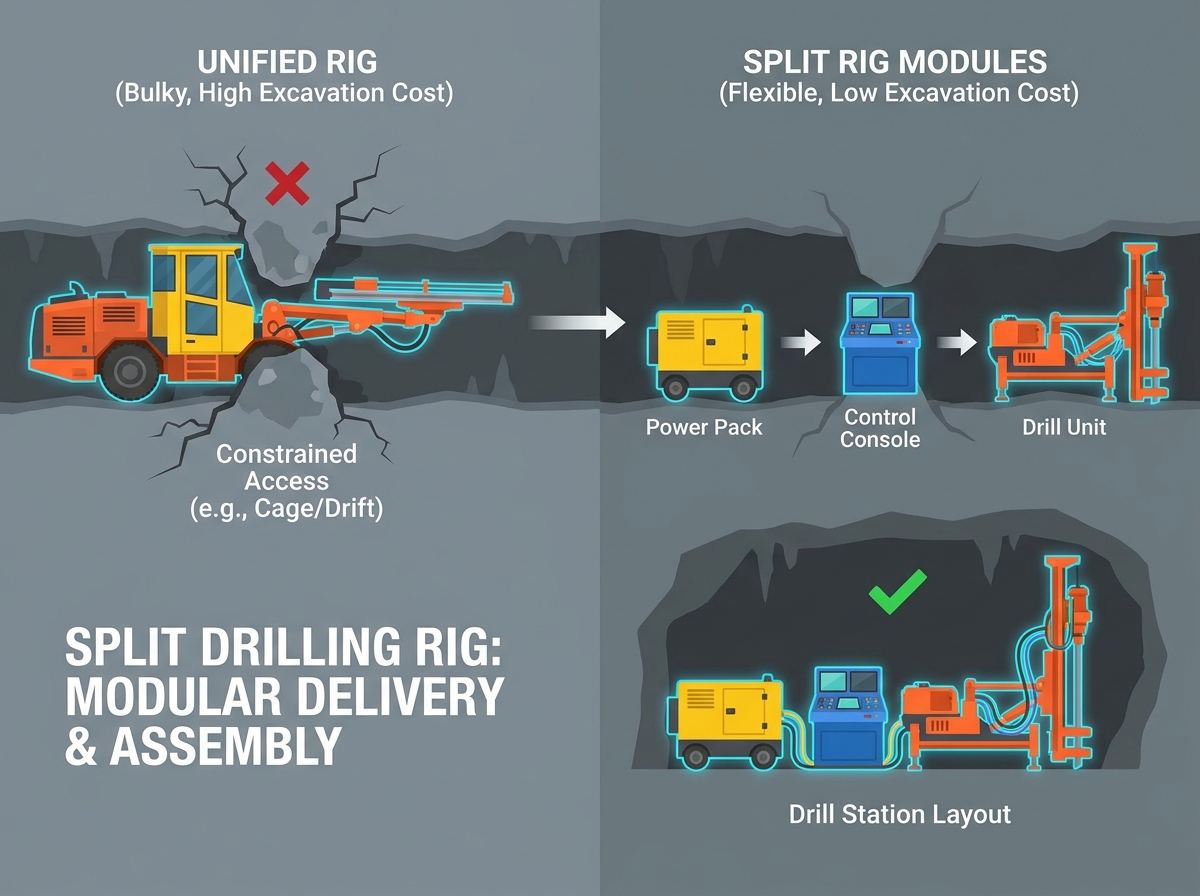
Purpose-built split drilling rigs solve this by separating the power pack, control unit, and drill frame. However, realizing their ROI requires rigorous upfront logistical planning. This guide provides a decision-stage framework for evaluating access constraints, planning modular transport, and securing necessary underground utilities before deployment.
Access Dictates Selection: Cage dimensions, hoist capacities, and tramming routes must be measured against the largest single module of the rig, not just total weight.
Modular Flexibility: Modern hydraulic split drilling rigs allow for customized deployment footprints, but require precise sequencing during reassembly to ensure safety and alignment.
Utility Prerequisites: Independent power units demand specific ventilation (if diesel), voltage stability (if electric), and water flow rates that must be verified before mobilization.
Total Cost of Deployment: Evaluating a rig requires calculating not just the purchase or lease price, but the operational hours saved by bypassing drift enlargement and simplifying maintenance.
Unified drilling setups in deep underground operations force a difficult choice. You must either select a suboptimal drill station location, or you must execute highly expensive excavation. Carving out hard rock to accommodate a massive rig drains project budgets. It also delays critical drilling schedules.
A successful underground deployment depends on specific criteria. It minimizes mobilization downtime. It avoids unnecessary excavation costs entirely. Most importantly, it maintains a safe working perimeter for your operators. Finding this balance requires equipment adaptability.
Evaluating traditional rigs against modular alternatives highlights distinct trade-offs. Traditional rigs carry high excavation costs but require low assembly time at the face. Conversely, modular systems drop excavation requirements significantly while adding moderate assembly hours. We must carefully assess these operational trade-offs before mobilization.
Split systems require careful hydraulic hose management. You must also plan for multiple transport trips down the decline. However, they offer unparalleled flexibility in tight drifts and crosscuts. They maneuver where monolithic rigs simply cannot go.
Feature | Traditional Unified Rigs | Split Configuration Rigs |
|---|---|---|
Excavation Requirements | High (often requires drift enlargement) | Low (fits existing drift dimensions) |
Underground Assembly Time | Minimal (arrives mostly intact) | Moderate (requires module connection) |
Footprint Flexibility | Rigid and linear | Highly adaptable to corner setups |
Transport Logistics | Bottlenecked by shaft cage limits | Manageable via separate modular trips |
Thorough logistical mapping prevents expensive delays. Access pathways dictate which equipment you can realistically deploy. You must measure the shaft cage dimensions and decline ramp limits precisely. Look at length, width, and height against the manufacturer specifications.
Engineers must identify specific choke points along the tramming route. These include tight turn radii and uneven floor conditions. Low back heights also pose severe transport risks. You must evaluate the heaviest single module for safe handling.
Follow these steps to assess delivery constraints:
Map Cage Limits: Record maximum dimensions (LxWxH) and payload capacities of the mine shaft cage.
Identify Choke Points: Survey the tramming route for tight corners, low ceilings, and uneven floors.
Evaluate Module Weight: Weigh the heaviest single component. This is usually the power pack or the feed frame.
Confirm Handling Equipment: Check availability of LHD loaders, chain blocks, or overhead monorails at the drill station.
Assess Obstacles: Locate existing ventilation ducting, piping, and ground conditions. These easily impede skidded or crawler-mounted modules.
Weight distribution matters just as much as maximum payload. You must coordinate safe offloading and positioning once modules arrive. Unstable ground conditions will severely complicate the movement of heavy, skidded components. Addressing these obstacles early prevents stranded machinery.
Modern engineering deconstructs bulky equipment into manageable sections. Hydraulic split drilling rigs are divided into standard operational modules. Understanding these divisions helps crews plan the underground footprint accurately. The primary modules include the drill unit, the power pack, and the control console.
The drill unit contains the feed frame and rotation unit. Crews position this active working end directly at the rock face. The power pack houses the engine, motor, and hydraulic pumps. You can situate it remotely to reduce noise and heat at the drill collar. The control console serves as the operator station. You position it for optimal line-of-sight and safety. This keeps operators out of the direct line of fire.
You must strategically place the wireline winch and rod handling systems. When optimizing wireline coring rig layouts, consider the daily workflow. The footprint must accommodate safe rod tripping. It should also allow smooth core retrieval without crowding the operator.
Reassembly sequencing requires extreme precision. Teams must use factory-match marked hydraulic hoses and quick-connect fittings. This prevents dangerous cross-wiring. It also mitigates the risk of fluid contamination during underground assembly. One speck of dust in a hydraulic line causes massive pump failures.
Independent power units demand specific utility prerequisites. Electric-hydraulic systems require stable, high-voltage underground power grids. You must carefully evaluate cable routing, step-down transformers, and switchgear requirements. Electrical infrastructure limits dictate where you can position the rig.
Diesel-hydraulic systems offer greater mobility. However, they demand strict adherence to underground emissions standards. You must plan intricate fuel transport logistics. Diesel exhaust also places heavy burdens on existing mine ventilation systems.
Water management forms the lifeblood of drilling operations. Engineers must assess the required PSI and GPM for drill fluid flushing. This proves especially critical for deep-hole wireline coring. You must plan for return water management. Do not forget mud recovery and sump pump placement within the station.
Ventilation dictates ambient safety. Remote power packs generate immense heat loads. You must calculate this thermal output accurately. Ensure the drill station has adequate auxiliary ventilation. This maintains safe ambient temperatures for personnel. It also prevents catastrophic hydraulic fluid degradation.
Utility Type | Key Requirements | Common Pitfalls |
|---|---|---|
Power (Electric) | High-voltage stability, properly rated switchgears. | Voltage drops over long cable runs causing motor stalls. |
Power (Diesel) | Fuel transport logistics, exhaust scrubbers. | Violating local emissions limits due to poor exhaust routing. |
Water | Consistent PSI/GPM, return sumps, mud recovery. | Inadequate flushing pressure leading to stuck drill rods. |
Ventilation | Auxiliary fans, thermal load dissipation mapping. | Hydraulic overheating due to stagnant air pockets. |
Operating heavy machinery underground carries immense regulatory oversight. Industry-standard safety lenses govern every decision. MSHA and OSHA equivalents dictate strict spacing rules. Your split layout must maintain compliant egress routes at all times. Fire suppression clearances cannot be compromised.
The primary vulnerability of these modular rigs lies in their umbilical cords. Hydraulic hoses connect the separated modules. You must address this fragility directly. Discuss protective sleeving with your team. Route these lines away from foot traffic and moving equipment. Implement rigorous pressure testing protocols before spinning the rotation unit.
A poorly planned layout ruins maintenance accessibility. Blocking access to critical filter housings frustrates mechanics. Hiding tramming controls endangers operators during rig moves. Ensure your final footprint allows absolute 360-degree maintenance access to the power pack.
We must remain transparent about operational assumptions. Modular setups definitely save on excavation budgets. However, they require highly trained crews for initial setup. Commissioning these machines in dusty environments demands clean-room levels of care. Hydraulic contamination remains the number one cause of premature pump failure in these applications.
Upfront logistical planning dictates the success of modular underground drilling. When evaluating vendor proposals, scrutinize the data closely. Prioritize suppliers who provide exact module weights and lifting point schematics. They must also deliver detailed utility requirements, not just total rig specifications.
Before signing a procurement or lease agreement, take definitive action. Conduct a physical or 3D digital walk-through of the entire tramming route. Use the rig's maximum single-module dimensions during this simulation. Verifying physical access and utility capacities guarantees a smoother, safer underground deployment.
A: The heaviest component is usually the remote power pack or the main feed frame. You must verify specific model weights directly against your mine shaft cage limits and hoist capacities prior to transport.
A: Placement depends entirely on hydraulic line limitations, including pressure drop and internal hose friction. Typically, operators restrict this distance to a safe radius of 10 to 30 meters, depending on hose diameter and pump capacity.
A: Yes. Reassembly, hose connection, and hydraulic bleeding add initial hours to your setup. However, this downtime is almost always offset by the days or weeks saved by avoiding hard rock drift enlargement.
A: Both have distinct trade-offs. Electric systems eliminate local emissions and drastically reduce ventilation demands, but they require robust existing electrical infrastructure. Diesel offers excellent mobility and flexibility at the cost of strict air quality management.