+86-15829664021
liangma0318@gmail.com
- All
- Product Name
- Product Keyword
- Product Model
- Product Summary
- Product Description
- Multi Field Search


Views: 0 Author: Site Editor Publish Time: 2026-07-25 Origin: Site
Navigating the high-stakes reality of soft coal environments demands extreme precision. Low compressive strength, high friability, and active gas migration make borehole collapse a persistent threat. Operators face immense pressure to keep operations running smoothly. Complex geology often disrupts even the most carefully designed drilling plans.
Unfortunately, frequent non-productive time directly impacts project viability. Stuck pipe incidents occur constantly during operations. Lost circulation drains valuable resources. Poor hole cleaning creates impassable blockages deep underground. These operational issues compound quickly, threatening schedules and stretching budgets severely.
You need robust strategies to overcome these geological hurdles. This article provides engineers and procurement teams an evidence-based framework for stabilizing boreholes. We will explore optimized fluid mechanics, advanced rig selection, and active risk mitigation. By understanding these dynamics, you can execute safer, more efficient directional drilling programs.
Borehole stability in soft coal requires balancing mechanical support (drilling fluid pressure) with chemical inhibition to prevent coal matrix swelling and degradation.
Selecting specialized directional drilling rigs for soft coal seams involves prioritizing precise pressure control, low-RPM torque capacity, and continuous surveying (MWD) capabilities.
Over-pressurizing drilling fluid is a primary cause of induced fractures; successful deployment relies on real-time annular pressure monitoring rather than static mud weight estimates.
Standardizing contingency protocols for gas kicks and sudden coal sloughing drastically reduces equipment loss and NPT.
Every borehole failure directly threatens your operational timeline. Lost bottom-hole assemblies trap expensive capital underground. Fishing operations to retrieve these assemblies consume days of scheduled time. Extended drilling days consume operational budgets rapidly. Furthermore, delayed gas drainage or coal extraction pushes revenue milestones further away. You must recognize these delays as severe business risks. Unplanned side-tracks often become necessary, multiplying the original drilling footprint.
We categorize primary failure modes into three distinct areas. Understanding these modes helps teams apply the correct preventive measures.
Mechanical collapse occurs when mud weight provides inadequate shear support. The weak coal simply caves into the void. This typically happens when formation pore pressure exceeds the hydrostatic pressure of the fluid.
Fracture breakdown represents catastrophic tensile failure. Excessive circulating pressure physically splits the formation apart. This forces valuable fluid deep into the coal seam, leaving the wellbore dry and unstable.
Chemical degradation happens when coal hydration initiates dispersion. Water reacts with native clays, causing the matrix to swell and disintegrate. This slow degradation constantly weakens the borehole roof over several days.
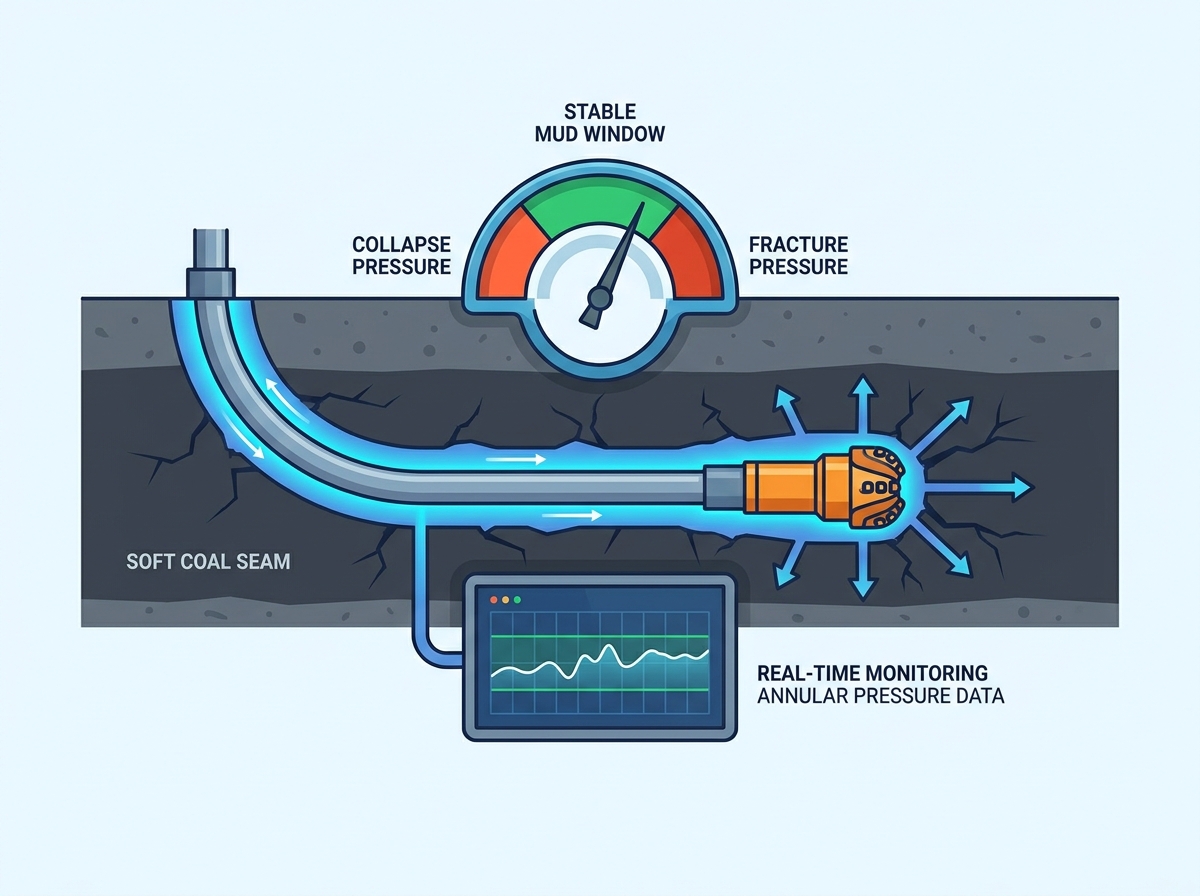
Success hinges on establishing a stable mud window. This defines the safe pressure range between pore pressure collapse and fracture initiation. Staying within this narrow band ensures uninterrupted continuous drilling. Industry frameworks emphasize real-time monitoring to maintain this critical balance. Operating outside this window guarantees eventual wellbore failure.
Addressing the mechanics of fluid-based stabilization prevents catastrophic cave-ins. Operators borrow heavily from industry best practices for slurry management. We must treat fluids as primary structural support components. They act as liquid casing before installing steel pipes.
Mud weight calibration requires extreme care. You must balance equivalent circulating density (ECD) perfectly. ECD combines static fluid weight and dynamic friction forces. If ECD exceeds the coal seam's fracture gradient, you risk sudden fluid loss. Conversely, if it drops too low, the borehole wall collapses inward. Engineers map this pressure gradient constantly to adjust fluid properties dynamically.
Fluid chemistry and filtration control dictate long-term stability. Standard bentonite often fails in friable coal. Bentonite requires high solids content, which increases ECD dangerously. Instead, modern operators prefer specialized polymers. Polymers provide excellent viscosity at lower weights. They wrap sensitive clay particles, preventing them from absorbing water.
Bridging agents play an equally critical role here. Engineers often use sized calcium carbonate to plug tiny pores. They create an impermeable filter cake along the wellbore. This thin, tough barrier prevents fluid invasion into micro-fractures. It keeps the coal matrix intact, dry, and structurally sound.
Hole cleaning efficiency relies heavily on optimized viscosity. Horizontal wellbores demand highly specific fluid rheology. The fluid must suspend large, brittle coal cuttings efficiently. It then transports them out of the hole without eroding the fragile walls. Insufficient viscosity leads to cutting beds. These beds accumulate on the low side of the hole. They inevitably cause stuck pipe incidents during tripping operations.
Fluid Property Focus | Standard Bentonite System | Specialized Polymer System |
|---|---|---|
Solids Content Level | High (Increases density rapidly) | Low (Maintains safe weight limits) |
Chemical Inhibition | Poor to Moderate | Excellent (Prevents swelling) |
Impact on Dynamic Pressure | Significantly increases ECD | Minimal ECD fluctuation |
Hole Cleaning Efficiency | Requires aggressive pump rates | Highly efficient at moderate rates |
Filter Cake Quality | Thick and permeable | Thin, tough, and impermeable |
How do you shortlist equipment built specifically for friable, low-strength geology? General-purpose oilfield rigs rarely succeed here. You must prioritize hardware designed for extreme finesse. Evaluating directional drilling rigs for soft coal seams requires analyzing several core specifications meticulously.
Rotary and torque specifications dictate mechanical interaction with the wellbore. High-torque, low-RPM capabilities are absolutely non-negotiable. Soft coal cannot withstand aggressive, high-speed rotation. High RPMs mechanically agitate the borehole wall, accelerating sloughing. High torque ensures continuous bit rotation even under heavy loads. This steady power delivery prevents the bit from stalling.
Steering and trajectory control demand careful assessment. Operators often debate Rotary Steerable Systems (RSS) versus conventional mud motors. RSS offers continuous rotation, reducing lateral friction significantly. It minimizes micro-doglegs along the wellbore path. Micro-doglegs increase mechanical stress during pipe movement. Smooth, predictable trajectories prevent unnecessary wall scraping. They preserve the natural structural integrity of the coal seam.
Measurement While Drilling (MWD) tools function as your underground eyes. Real-time annular pressure sensors are completely essential. Gamma-ray logging helps the bit stay perfectly within the target coal seam. These sensors detect early pressure spikes instantly. You cannot react to downhole changes using delayed surface gauges alone. Immediate telemetry allows drillers to adjust parameters before fractures initiate.
Pumps and pressure management systems round out the hardware evaluation. Look for rigs featuring automated pump controls. Manual pump engagement often causes severe, sudden pressure surges. These abrupt surges fracture the fragile formation during routine drill pipe connections. Automated ramp-up sequences protect the wellbore integrity automatically. They introduce flow gradually, allowing the wellbore to acclimate to dynamic pressure safely.
Executing these programs in the field presents significant practical hurdles. Theoretical plans often clash directly with harsh operational realities. We must acknowledge these challenges to build trustworthy deployment strategies. Real-world experience separates successful campaigns from costly failures.
Consider the well-known "paper vs. field" mud window dilemma. Pre-drill geological models often overestimate coal strength. Engineers might calculate a comfortably wide safe operating margin initially. Once drilling begins, the actual pressure window proves terrifyingly narrow. Operators must rely exclusively on real-time ECD monitoring. Surface estimations hold little value when formation integrity shifts unexpectedly. You must adapt your fluid parameters dynamically based on actual downhole feedback.
Crew competency directly impacts overall borehole stability. Aggressive tripping speeds introduce massive, unnecessary risks. Fast pipe movement causes dangerous swab and surge pressures. Pulling out too fast creates a strong vacuum effect. This swabbing vacuum literally pulls soft coal chunks into the wellbore. Running in too fast pushes fluid violently into the formation. These extreme mechanical forces physically tear down the borehole wall.
Best Practice: Enforce strict tripping speed limits systematically. Mandate regular team training on swab and surge dynamics. Use a trip tank to monitor fill volumes accurately.
Common Mistake: Rushing drill pipe connections to save minor rig time. This impatience ultimately causes days of non-productive time due to massive hole collapse.
Fluid contamination risks compound silently over time. Fine coal dust alters slurry rheology significantly. As drilling progresses, sub-micron particles bypass standard mechanical shakers. They build up steadily in the active fluid system. This microscopic accumulation increases viscosity and density dangerously. Active solids control equipment becomes entirely mandatory. High-speed centrifuges must run continuously to maintain original fluid properties.
Project managers face daunting choices during complex vendor selection. A structured evaluation framework removes subjective guesswork. We recommend rigorous vetting based strictly on empirical performance. You need partners who understand geological fragility natively.
First, demand verifiable field data aggressively. Vendors must prove their rig's performance in similar friable coal basins. Do not accept general oilfield or hard-rock statistics. Soft coal behaves entirely differently than shale or competent sandstone. Assess integration capabilities next. The rig provider and the mud engineering team must collaborate seamlessly. Miscommunication between pump operators and fluid engineers guarantees failure.
Pilot testing offers a safe, controlled validation method. Start with a scaled pilot hole carefully. Alternatively, drill a limited-reach lateral section first. This step validates your fluid design and rig steerability safely. Monitor cutting returns and torque trends closely during this phase. Do not commit to multi-well pad drilling without this empirical proof.
Your immediate actionable next step involves detailed geomechanical data gathering. Conduct a thorough geomechanical audit of the target seam. Define baseline pressure parameters accurately. Measure precise compressive strengths and native pore pressures. Complete this vital step before issuing any formal rig RFPs. Clear operational data ensures vendors bid appropriate technologies.
Borehole stability never stems from deploying a single miraculous tool. It relies entirely on precise alignment across multiple technical disciplines. Fluid chemistry, rig capability, and strict operational discipline must work together seamlessly. Skipping any single element compromises the entire drilling operation.
Investing in advanced monitoring yields massive compounding returns. Specialized directional equipment reduces costly non-productive time drastically. These strategic investments ensure safer daily operations and highly predictable project timelines. By deeply respecting the formation's fragility, you guarantee far better operational outcomes.
Take proactive action today to protect your upcoming drilling programs. Consult directly with a qualified drilling engineer regarding your specific site challenges. Request detailed technical specifications for specialized soft-coal rig configurations to begin your planning phase properly.
A: The ideal choice is a non-damaging, low-solids polymer mud. Standard bentonite systems are too heavy and lack proper inhibition. Polymer systems provide excellent viscosity at lower weights. They utilize bridging agents to build an impermeable filter cake, preventing fluid invasion and subsequent coal degradation.
A: ECD combines the static weight of the drilling fluid with the dynamic friction generated during pumping. If ECD exceeds the formation's fracture gradient, the pressure cracks the coal. This causes severe fluid loss, destabilizes the surrounding matrix, and often leads to immediate borehole collapse.
A: Operators should watch for several critical indicators. Erratic torque suggests chunks of coal falling into the wellbore. Sudden increases in pump pressure indicate blockages. You may also notice excessive cutting volumes arriving at the surface shakers, or experience significant overpull during drill pipe connections.