+86-15829664021
liangma0318@gmail.com
- All
- Product Name
- Product Keyword
- Product Model
- Product Summary
- Product Description
- Multi Field Search


Views: 0 Author: Site Editor Publish Time: 2026-07-14 Origin: Site
Operating in underground coal mines involves absolute spatial and logistical constraints. You face a harsh reality every single shift. Equipment selection becomes a critical bottleneck for vital gas drainage and water exploration projects. Tunnel profiles consistently tighten over time. Simultaneously, regulatory safety standards increase across the global industry. Because of these colliding factors, mine operators face a specific procurement choice. Do you stick with high-capacity standard rigs? Or do you transition to specialized narrow-body profiles? This choice directly impacts your project feasibility and overall safety margins. We built this guide to break down the structural, operational, and financial trade-offs. You must compare standard units against modern compact alternatives. Our goal is simple. We want to help your engineering and procurement teams make an evidence-based selection. You will learn exactly how to balance spatial agility against raw drilling power.
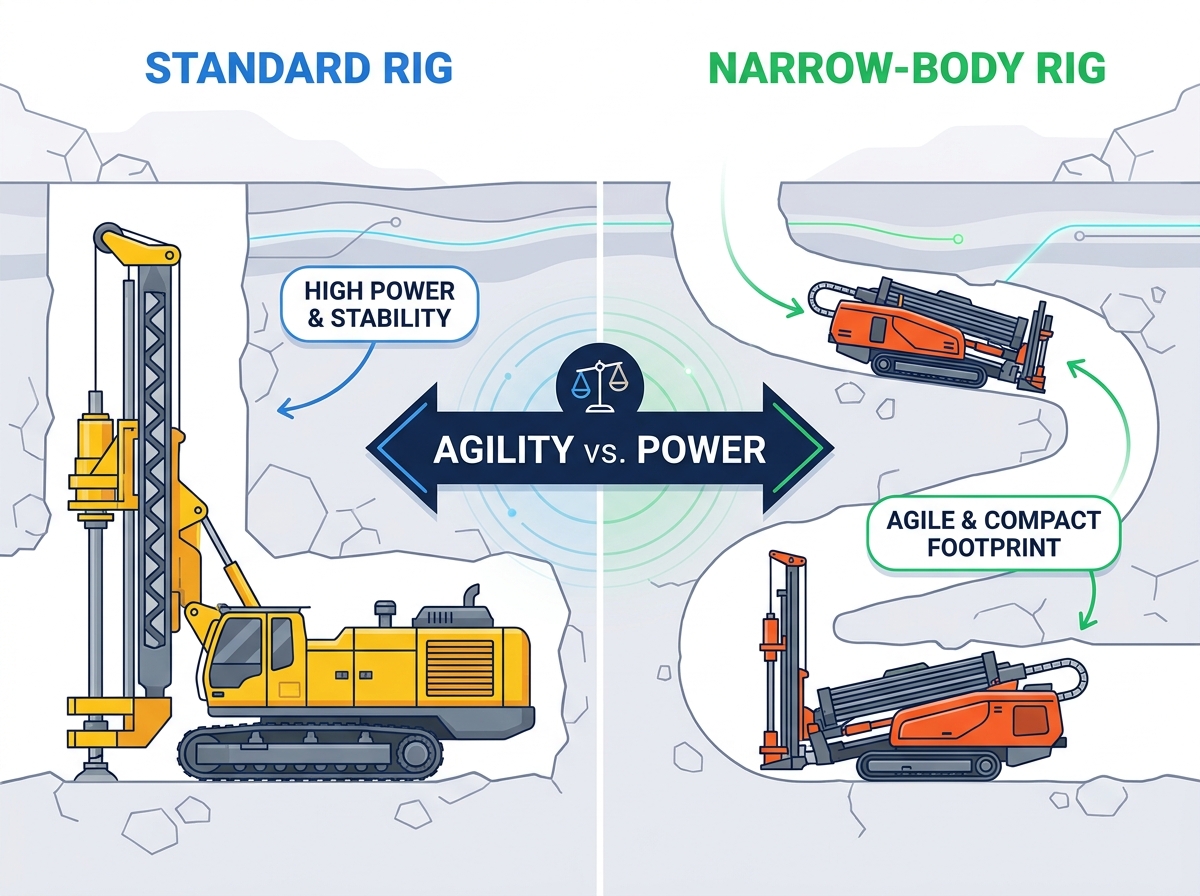
Spatial Agility vs. Raw Power: Narrow-body rigs drastically reduce transport and setup times in constrained drifts, though standard rigs maintain a ceiling advantage in maximum torque and extreme deep-hole drilling.
Logistics Impact: A narrow-body directional drilling rig eliminates the need for extensive tunnel widening and complex modular breakdowns during cage transport.
Application Fit: Standard rigs remain optimal for centralized, large-scale drilling stations; narrow-body units excel in dynamic, multi-lane deployment and fractured geological conditions requiring frequent relocation.
Compliance: Both formats must meet stringent explosion-proof (e.g., MSHA, ATEX) standards, but narrow-body designs require specialized maintenance access considerations due to compacted internal components.
Moving heavy machinery through underground cages creates significant friction. Narrow crosscuts and uneven floor conditions compound this logistical nightmare. Historically, this struggle causes more downtime than actual drilling. We call this the mobility-productivity paradox. A massive drill might offer incredible power on paper. However, it loses value if you cannot move it efficiently between drilling stations. Crews often spend hours unbolting hydraulic lines and removing drill masts just to pass through a choke point.
You must evaluate equipment for very specific use cases. Primary applications include in-seam methane drainage, roof or floor water exploration, and geological anomaly detection. Each application demands unique spatial requirements. Methane extraction remains a non-negotiable safety prerequisite. You must complete it before active mining can commence. Therefore, drilling speed directly dictates overall mining progress.
Procurement teams often focus solely on the basic equipment purchase price. We recommend a different approach. You should calculate the holistic Total Cost of Deployment (TCD). This metric captures the hidden expenses of underground preparation. It includes tunnel widening costs, transport labor, and rig relocation frequency. When you evaluate TCD, equipment mobility often becomes more valuable than maximum torque.
Traditional drill rigs dominate the industry for a specific reason. They deliver unmatched raw power for the most demanding geological environments.
Core Strengths:
They offer extremely high push-pull capacity.
They provide superior rotary torque for long-distance borehole completion.
A heavier, wider chassis ensures enhanced stability during high-pressure drilling operations.
Widespread operator familiarity heavily reduces initial training time for new crews.
You can easily source aftermarket parts from global mining supply chains.
Despite these undeniable benefits, standard rigs introduce severe operational friction points. These limitations become glaringly obvious in older mines.
Operational Friction Points:
Their large footprint often necessitates dedicated drilling chambers. If chambers are unavailable, you face immensely costly tunnel widening.
Bulky dimensions require time-intensive disassembly and reassembly. You must break them down entirely to pass through standard mine shafts.
They present a higher risk of disrupting concurrent underground transport traffic. Mobilization blocks critical secondary lanes for extended periods.
Common Mistake: Many operators heavily underestimate the true cost of tunnel widening. Blasting and securing a dedicated drilling chamber can delay a project by weeks. This delay destroys your planned production schedule.
Engineers fundamentally redesign these machines from the ground up. The design architecture of a narrow-body directional drilling rig differs structurally from traditional models. Manufacturers utilize vertical component stacking. They place hydraulic pumps directly over the primary tramming motors to save lateral space. They integrate a highly compact crawler chassis. They also deploy highly condensed power packs.
These structural shifts create powerful strategic advantages for mine operators.
Direct Transportability: Designers engineer them to fit standard mine cages. They navigate narrow tramways seamlessly without requiring major disassembly.
Rapid Deployment: Self-propelled tracked mobility offers extremely quick navigation. You can conquer tight turning radii and execute rapid station-to-station moves.
Minimal Footprint: They operate comfortably in standard roadway widths. You never block vital ventilation flows or secondary transport lanes.
Every engineering choice introduces specific trade-offs. You might face limitations in absolute maximum borehole depth. Compacting the power unit naturally concentrates heat generation. Therefore, you must utilize highly efficient thermal management systems. Neglecting heat dissipation will cause premature hydraulic failure. Your maintenance teams must monitor fluid temperatures rigorously during continuous drilling shifts.
You need clear metrics to choose the right system. Let us examine how these two formats compare across critical operational categories. This evaluation matrix will guide your final procurement strategy.
A standard rig often exceeds 1.5 meters in overall width. Conversely, narrow alternatives typically stay under 1.2 meters. This seemingly minor difference dictates whether you must widen a drift. Narrow designs boast superior turning radius capabilities. They maintain higher tramming speeds across deeply uneven mine floors. Their balanced center of gravity prevents tipping during transit. You can navigate acute crosscut angles easily. Traditional rigs often require complex shunting maneuvers to negotiate these same corners.
Engineers measure efficiency by analyzing torque output versus physical size. Standard rigs win on absolute peak torque. However, compact rigs offer an exceptional power-to-weight ratio. Let us look at effective drilling depth limits. Standard models routinely surpass 1000 meters in favorable, uniform conditions. Compact models handle 300 to 600 meters reliably. Your specific coal seam hardness and surrounding rock interfaces will dictate actual depth limits. For most routine drainage tasks, a compact model provides more than enough power.
Labor hours drastically affect your operational bottom line. We must carefully compare the time required to anchor, align, and initiate drilling. Standard modular rigs take entire shifts to assemble. Crews must reconnect dozens of hydraulic hoses. Unified compact designs deploy in mere hours. This shift productivity gap compounds massively over a single year. A unified design entirely eliminates the risk of misplacing critical connecting components during transit.
Both categories require rigorous explosion-proof certifications. However, compacting electrical and hydraulic systems complicates this compliance. Inspectors heavily scrutinize heat buildup within tight enclosures. Line-of-sight matters immensely in tight clearance zones. Compact designs often place the operator station strategically. This improves overall ergonomics and heavily reduces blind spots. An operator can safely monitor the drill string while remaining clear of high-pressure zones.
Navigability and Setup Comparison Chart
Evaluation Metric | Standard Rigs | Narrow-Body Rigs |
|---|---|---|
Average Transport Width | 1.5m to 2.0m | 0.9m to 1.2m |
Assembly Requirement | Heavy disassembly needed | Direct cage transport |
Average Setup Time | 8 to 12 hours | 2 to 4 hours |
Optimal Application | Static deep-hole drilling | Multi-station agile drilling |
Transitioning to a new equipment paradigm carries inherent risks. You must evaluate these operational factors before signing a final purchase order. A proactive approach prevents catastrophic project delays.
Maintenance Realities:
These specialized machines feature densely packed components. Mechanics often struggle when navigating tight internal clearances. You must evaluate the ease of replacing hydraulic hoses directly on-site. Replacing a buried directional valve might require removing adjacent mechanical systems. Ask vendors for detailed maintenance access schematics before buying. Ensure your crews possess the specific compact tooling required for these confined spaces.
Operator Adoption:
Drilling crews develop deep muscle memory on standard wide-stance rigs. Transitioning them to compact units requires dedicated, structured training. Operators must learn the specific nuances of a precision-balanced chassis. They must understand the distinct tactile feedback originating from a smaller hydraulic system. We recommend running supervised pilot shifts to build operator confidence safely.
Strata Matching:
You face a very real risk of under-sizing your rig. Ensure your selected unit possesses sufficient pullback force. Unexpected fault zones or sudden borehole collapses demand massive spikes in torque. If your rig lacks necessary reserve power, you will lose expensive drill strings underground. Always map your geological fault lines before finalizing rig specifications.
Vendor Support & Parts Availability:
Supply chain reliability literally makes or breaks your deployment. You must assess how quickly the manufacturer can deliver specialized compact components. You cannot rely on standard off-the-shelf parts for these highly unique machines. Connect with suppliers to proactively secure critical spare parts inventories. Quality directional drilling rigs for underground coal mines require dedicated post-sale support ecosystems.
Best Practice: Always stock high-wear items locally at the mine site. Keep spare thermal management sensors and bespoke hydraulic fittings in your dedicated underground cache.
Summary Judgment: Standard rigs win decisively on brute force and ultimate drilling depth. Conversely, narrow-body rigs win entirely on agility, rapid cycle times, and drastically reduced infrastructure prep.
Shortlisting Logic: Match the rig selection directly to your mine's specific geological layout. Do you face a high relocation frequency? Are your tunnels historically narrow? If so, prioritize the narrow-body architecture. You will quickly recover the initial investment through eliminated tunnel-widening costs and reduced mobilization labor.
Next Steps: Request payload and dimension schematics from your shortlisted vendors. Run a rigorous transport simulation through your specific mine cage dimensions. Finally, conduct a supervised on-site pilot test to validate performance against your local strata conditions.
A: Depth heavily depends on the local strata and specific drill pipe dimensions. However, modern units frequently achieve 300 to 600 meters. This impressive operational range steadily closes the historical performance gap compared to standard large-scale rigs.
A: Yes. All electrical and mechanical systems must meet rigorous underground coal mine standards. These critical standards include MA certification in China and MSHA in the United States. This absolute requirement makes advanced thermal management crucial in compact designs.
A: Not necessarily. Engineers achieve remarkable stability through advanced hydraulic anchoring systems. They also utilize specialized mast-to-floor bracing techniques. These robust mechanisms easily compensate for the narrower track gauge during high-pressure continuous drilling operations.
A: The time savings are incredibly substantial. Operators entirely eliminate the need for major disassembly, complex reassembly, and specialized tunnel widening. Through these workflow efficiencies, crews typically reduce mobilization time by 30% to 50% per relocation.