+86-15829664021
liangma0318@gmail.com
- All
- Product Name
- Product Keyword
- Product Model
- Product Summary
- Product Description
- Multi Field Search


Views: 0 Author: Site Editor Publish Time: 2026-07-03 Origin: Site
Modern underground coal extraction requires an absolute balance. You must push aggressive production targets while maintaining zero-tolerance safety environments. Operating in spaces prone to methane and coal dust risks leaves no margin for error. Procurement engineers and mine operators face immense pressure when upgrading machinery. You need a highly reliable and compliant fleet to keep operations moving. This guide provides a practical framework for evaluating, shortlisting, and implementing modern drilling systems. We will explore core equipment categories, key performance indicators, and strict safety compliances. You will also learn how seam geology and regional regulations shape your final procurement decisions. Every mine presents unique geological challenges. Thick seams demand different approaches than narrow veins. Infrastructure heavily influences your final choices. Upgrading a fleet requires careful planning. We highlight these critical nuances clearly. By following these insights, you can protect your workforce. You will also avoid costly mismatches during implementation.
Selecting underground coal mine drilling equipment requires prioritizing intrinsically safe/explosion-proof ratings alongside penetration efficiency.
Underground directional drilling rigs are becoming essential for pre-drainage of methane and advanced geological exploration.
Procurement decisions should weight long-term maintenance accessibility and operator training requirements as heavily as upfront capital expenditure.
Electro-hydraulic systems are standardizing due to efficiency, but require rigorous fluid fire-resistance compliance.
When evaluating new machinery, you need precise metrics to measure success. You cannot rely on broad estimates. Production metrics dictate daily output capabilities. Track penetration rates carefully. High penetration rates indicate efficient power transfer from the rig to the rock face. Setup and teardown times matter immensely in restricted areas. Confined headings restrict movement. Fast rig deployment keeps production schedules intact. You must track Mean Time Between Failures (MTBF). A high MTBF indicates reliable machinery. It reduces exposure to hazard zones during unexpected breakdowns.
Strata control requires ultimate precision. Roof bolting operations must remain accurate under intense pressure. Effective methane drainage volumes directly impact mine ventilation safety. You must extract gas efficiently before the shearer advances. Dust suppression efficacy ensures compliance with breathable air standards. High-pressure water systems must trap particulates immediately.
Success metrics heavily depend on continuous monitoring. Modern rigs often incorporate digital telemetry. You can pull data directly from the machine. Analyzing this data highlights operational bottlenecks. You can adjust drilling parameters in real time. We recommend establishing baseline KPIs before introducing new equipment. Compare the new machine against legacy performance data. This ensures your upgrades deliver tangible improvements.
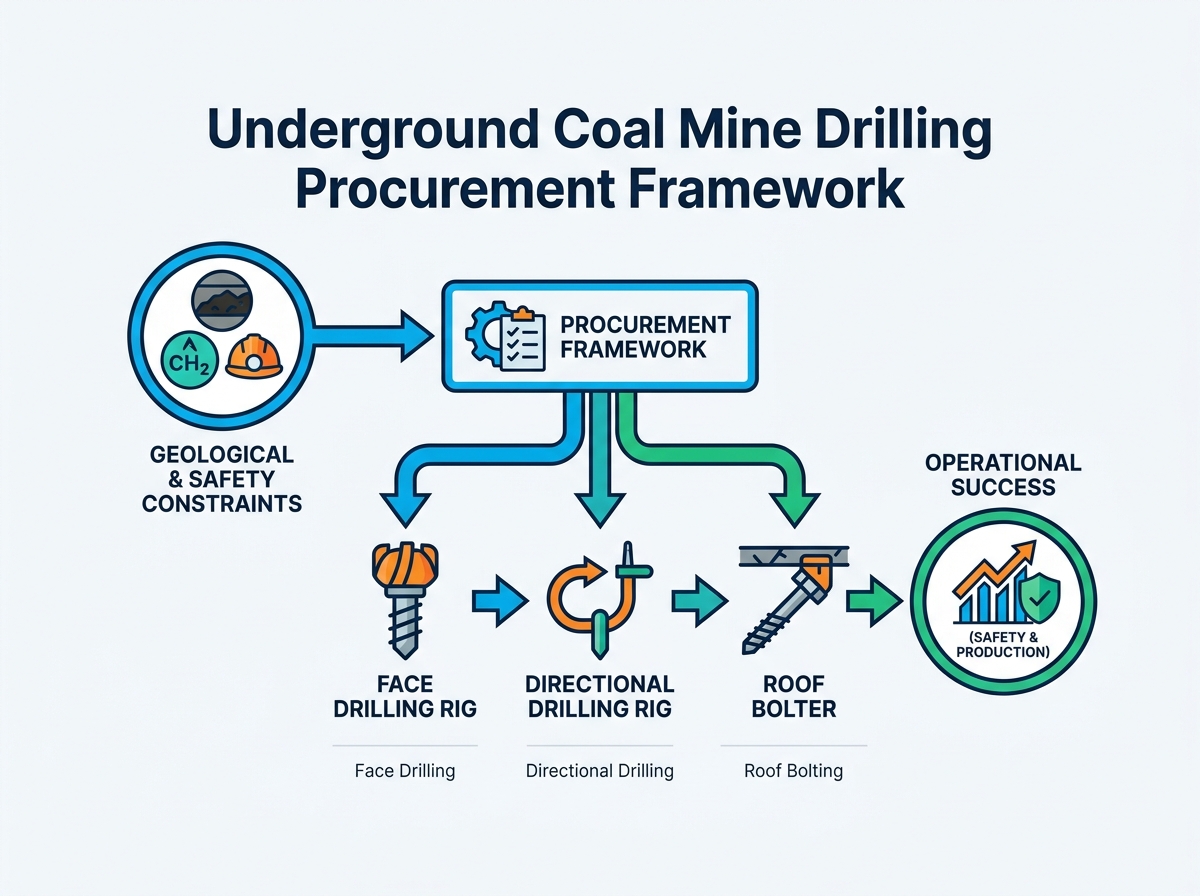
Procuring robust underground coal mine drilling equipment requires careful planning. We must align machine specifications to actual mine conditions. The market offers distinct categories designed for specific applications. Understanding these differences prevents critical misapplications.
Core Equipment Categories Table
Equipment Type | Primary Application | Key Evaluation Metric |
|---|---|---|
Face Drilling Rigs | Conventional drill-and-blast in hard coal | Boom flexibility & footprint |
Directional Drilling Rigs | Methane drainage & geological exploration | Steering accuracy & MWD integration |
Roof Bolters | Strata reinforcement and rib support | Resin injection automation & canopy safety |
Face drilling rigs execute conventional drill-and-blast operations. You deploy them when cutting through hard coal or tough rock bands. Continuous miners often struggle in these conditions. Face drills bore precise hole patterns for explosives. Evaluation criteria focus heavily on boom flexibility. Operators need extensive reach from a single setup position. Parallel holding capabilities ensure straight holes. Straight holes guarantee optimal blast fragmentation. You must also evaluate the footprint-to-power ratio. Narrow headings demand compact machines. However, you still need sufficient hydraulic power to maintain high penetration rates. Bulky rigs slow down tramming speeds. They also complicate passing maneuvers in tight tunnels.
Advanced underground directional drilling rigs handle highly specialized tasks. You use them for in-seam and cross-measure drilling. They extract methane before mining begins. They also facilitate water infusion for dust control. Furthermore, they detect geological anomalies ahead of the face. Evaluation criteria center on Measurement While Drilling (MWD) integration. MWD provides real-time data regarding hole trajectory. It also identifies changes in rock strata. Steering accuracy over long distances is non-negotiable. Deflection causes missed targets. Pullback force capacity represents another critical metric. You need massive pullback power to retrieve drill strings from deep, collapsing boreholes.
Roof bolters provide essential strata reinforcement. They secure the roof and ribs immediately after excavation. Unsupported spans pose severe fatality risks. Evaluation criteria focus on carousel capacity. Larger carousels hold more bolts. This reduces manual handling by operators. Resin injection automation improves installation consistency. Automated systems mix and inject resin precisely. This guarantees optimal bolt bonding. Operator canopy safety ratings require strict scrutiny. The canopy must withstand massive rock falls. Falling Object Protective Structures (FOPS) ratings are mandatory. Ergonomic controls inside the cabin reduce operator fatigue. Fatigue leads to installation errors. Errors compromise the entire strata support system.
Safety compliance dictates every engineering decision underground. You cannot bypass HazLoc standards. Regulatory bodies enforce strict rules regarding equipment design. Understanding these rules ensures your fleet remains legal and safe.
Explosion-Proof (Ex) and Intrinsically Safe (IS) designs are mandatory. Motors and sensors must operate safely in Class I, Division 1 environments. These zones feature constant methane exposure. Intrinsically safe circuits utilize low energy levels. They cannot generate sparks hot enough to ignite gas. Explosion-proof enclosures contain internal ignitions. If gas enters a motor and ignites, the heavy steel casing withstands the blast. Flame paths cool the escaping gases. They prevent flames from reaching the outside atmosphere. You must inspect these enclosures regularly. Scratches on flame paths destroy their cooling properties.
Fire-resistant hydraulics introduce significant maintenance complexity. Standard mineral oils pose severe fire risks. Systems utilizing HFA or HFB fire-resistant fluids resist ignition. However, these fluids lack the lubricity of standard oils. Pump longevity often suffers. The high water content accelerates internal wear. You must monitor seal maintenance closely. Upgrading to specialized seals prevents premature leaks. Filtration systems must remove tiny contaminants. Contaminated fire-resistant fluid destroys valve blocks rapidly.
Dust suppression integrates directly with mine ventilation. Coal dust explosions cause catastrophic damage. Wet drilling capabilities force water through the drill string. This process captures airborne particles immediately at the bit. Onboard scrubber systems clean the ambient air. High-powered fans pull dirty air through water sprays. You must maintain compliance with MSHA and NIOSH breathable dust limits. Failing these standards triggers immediate operational shutdowns. Regularly calibrating dust sensors prevents regulatory fines.
Procurement requires systematic evaluation. You cannot rely on vendor brochures alone. You must match machine capabilities against your specific operational environment. We outline a structured approach below.
Map Geological Constraints: Match equipment dimensions to seam thickness.
Assess Infrastructure: Verify electrical and water supply capacities.
Evaluate Automation Needs: Determine the required level of digital integration.
Audit Vendor Support: Confirm local spare parts availability.
Geological constraints dictate physical dimensions. Gallery profiles limit turning radii. A machine unable to navigate a crosscut becomes useless. Floor bearing capacity determines maximum allowable machine weight. Soft floors trap heavy electro-hydraulic rigs. You must evaluate tramming mechanisms. Tracked undercarriages distribute weight better than wheeled chassis. Seam undulations require high ground clearance. Articulated chassis designs improve maneuverability in twisting tunnels.
Comparison Chart of Power Sources
Power Source | Efficiency | Infrastructure Need | Best Application Environment |
|---|---|---|---|
Electro-Hydraulic | High | Heavy electrical reticulation | Modern, well-developed mines |
Pneumatic | Low | Legacy compressed air lines | Older mines, highly volatile zones |
Power source selection creates distinct trade-offs. Electro-hydraulic systems offer exceptional efficiency. They deliver smooth, consistent power to the drill face. However, they require substantial electrical infrastructure. You must manage heavy trailing cables safely. Pneumatic systems rely on legacy air lines. They offer lower efficiency but extreme durability. They operate well in highly volatile zones. Pneumatic tools cannot generate electrical sparks. However, they struggle to match modern production demands.
Automation and data readiness separate modern rigs from legacy fleets. Assessing the viability of semi-automated drilling cycles proves critical. Automation ensures consistent hole depth. It also prevents operators from forcing the bit. Remote operation panels remove workers from the immediate face. Fleet telemetry logging enables predictive maintenance. Telemetry sensors track oil pressures, temperatures, and vibration. Analyzing this data prevents catastrophic failures.
Vendor support audits guarantee long-term success. Evaluating OEM responsiveness prevents extended downtime. Local parts availability is paramount. Waiting weeks for a replacement valve halts production. Field service technician deployment SLAs dictate repair speeds. You need guaranteed response times. Ensure the vendor offers comprehensive simulator training. Practical support outweighs initial purchase discounts.
Bringing new equipment underground introduces friction. Planning for these realities ensures a smoother transition. Ignoring them guarantees operational delays.
Operator training bottlenecks often delay production. Transitioning from manual hydraulic controls to pilot-hydraulic systems involves a steep learning curve. Computerized systems require digital literacy. Operators accustomed to physical feedback struggle initially. They need significant simulator time. Push-button interfaces feel disconnected from the rock face. Thorough training builds confidence. Rushing deployment leads to smashed booms and broken drill strings. You must invest heavily in vendor-led training programs.
Maintenance in confined spaces presents severe logistical challenges. Real-world conditions complicate simple repairs. Changing out a heavy drifter underground requires specialized lifting gear. Tight clearances limit tool access. Mechanics often work in knee-deep mud. Poor lighting obscures visual inspections. You must evaluate machine serviceability during procurement. Grouped service points reduce maintenance time. Easy access to hydraulic manifolds prevents frustration. Machines designed for surface conditions fail quickly underground. They lack the necessary ruggedness and accessibility.
Infrastructure mismatches create hidden risks. Deploying advanced rigs without upgrading electrical reticulation causes voltage drops. Voltage drops damage sensitive electronic controllers. Upgrading water pressure supply systems remains equally important. Modern wet-drilling rigs consume massive amounts of water. Insufficient pressure compromises dust suppression. It also fails to flush cuttings from the borehole. Stuck drill strings halt progress completely. You must audit your utility networks before the rigs arrive. Proactive upgrades prevent costly commissioning delays.
The right drilling system aligns geological realities with strict safety compliance. Balancing production demands against hazardous environments remains your primary challenge. Procurement requires deep analysis of physical constraints and regulatory standards. You must prioritize equipment demonstrating proven reliability under extreme conditions. Evaluate every machine against your specific seam profile and ventilation limits.
Mine operators should map out their precise geological constraints immediately. Document your exact safety compliance requirements before contacting vendors. Request detailed technical specifications from OEMs. Demand transparency regarding maintenance accessibility. Finally, insist on rigorous pilot testing before finalizing fleet purchases. These steps ensure successful deployment and sustained operational safety.
A: Typically 15,000 to 20,000 engine/motor hours. This lifespan depends highly on maintenance adherence. Fluid cleanliness plays a massive role in hydraulic longevity. The operational environment also dictates overall durability. Strict servicing routines extend equipment viability.
A: They feature heavy explosion-proof enclosures for all electrical components. They utilize specialized fire-resistant hydraulic systems. Mandatory wet-drilling capabilities are built directly into the design. They also incorporate advanced dust collection mechanisms to handle volatile coal particulates.
A: Hydraulic hose abrasions occur frequently due to tight operating spaces. Seal failures happen often because of fluid contamination. Drifter wear parts require constant replacement. Electrical sensor faults commonly arise from moisture and heavy dust ingress.