+86-15829664021
liangma0318@gmail.com
- All
- Product Name
- Product Keyword
- Product Model
- Product Summary
- Product Description
- Multi Field Search


Views: 0 Author: Site Editor Publish Time: 2026-07-20 Origin: Site
Achieving a 1,000-meter horizontal trajectory within a coal seam requires absolute precision. You must manage extreme frictional drag. You must mitigate severe torque loss. You also need strict trajectory control throughout the entire process. Standard rotary drilling equipment routinely fails at this extreme depth. Borehole deviation escalates rapidly without specialized tools. Furthermore, conventional setups lack the necessary hydraulic power. They cannot clear heavy rock cuttings over such immense underground distances. We need a different, highly engineered approach to succeed.
This article outlines the precise in-seam directional drilling equipment needed to execute 1,000m+ boreholes safely and efficiently. You will learn how to achieve high target-hit rates reliably. We will explore the critical components, from crawler-mounted rigs to advanced measurement systems. This guide directly supports your procurement and project planning decisions. It breaks down the engineering realities of extended-reach underground drilling for modern mining applications.
Successfully drilling beyond 1,000 meters requires a high-torque crawler-mounted rig paired with a high-capacity mud pump.
Measurement While Drilling (MWD) technology and steerable downhole mud motors are non-negotiable for maintaining the drill string within the coal seam.
Evaluating long-distance directional drilling rigs demands a strict focus on pullback force, rotational torque, and underground safety compliance (e.g., explosion-proof certifications).
Implementation success depends equally on equipment specifications and the crew's ability to manage drilling fluid dynamics to prevent borehole collapse.
Friction compounds relentlessly over a 1,000-meter horizontal stretch. This mechanical reality dictates your entire equipment sizing strategy. As the drill string pushes deeper into the coal seam, the physical contact area increases. Drag builds exponentially against the borehole walls due to gravity and bending stresses. You lose vital rotational torque along the pipe length. We call this the capstan effect. You must account for this massive energy loss when sizing your underground machinery. If you underestimate friction, the drill string will stall completely.
Geological variables complicate this process significantly. Seam undulations force the drill path to bend continuously. Faults present sudden changes in rock mechanics and pressure zones. Coal hardness varies unpredictably across long distances. These geological factors accelerate equipment wear rapidly. They also trigger severe trajectory deviations if you ignore them. You need robust, adaptable machinery to handle these underground surprises safely.
We must redefine our success metric for these projects. Reaching 1,000 meters means nothing if the hole exits the coal seam early. We measure success by the effective drainage length. This metric represents the percentage of the borehole successfully maintained entirely within the target seam. High-quality machinery ensures you maximize this critical in-seam percentage. High in-seam ratios guarantee better gas extraction and safer subsequent mining operations.
The crawler-mounted rig serves as the mechanical heart of the operation. It provides the primary rotational torque needed to turn the pipe. It delivers essential push and pull forces to advance the bit. The crawler track design ensures vital mobility within confined underground mine galleries. This mobility allows crews to position the rig quickly between closely spaced boreholes.
You must differentiate between standard rigs and purpose-built extended-reach machines. Standard units lack the structural integrity for deep horizontal pushes. Extended-reach rigs feature reinforced feed frames and heavy-duty hydraulic chucks. They deliver continuous, high-capacity thrust without stalling. They also incorporate robust anchoring systems. These anchors secure the rig against the massive reactive forces generated during a one-kilometer push.
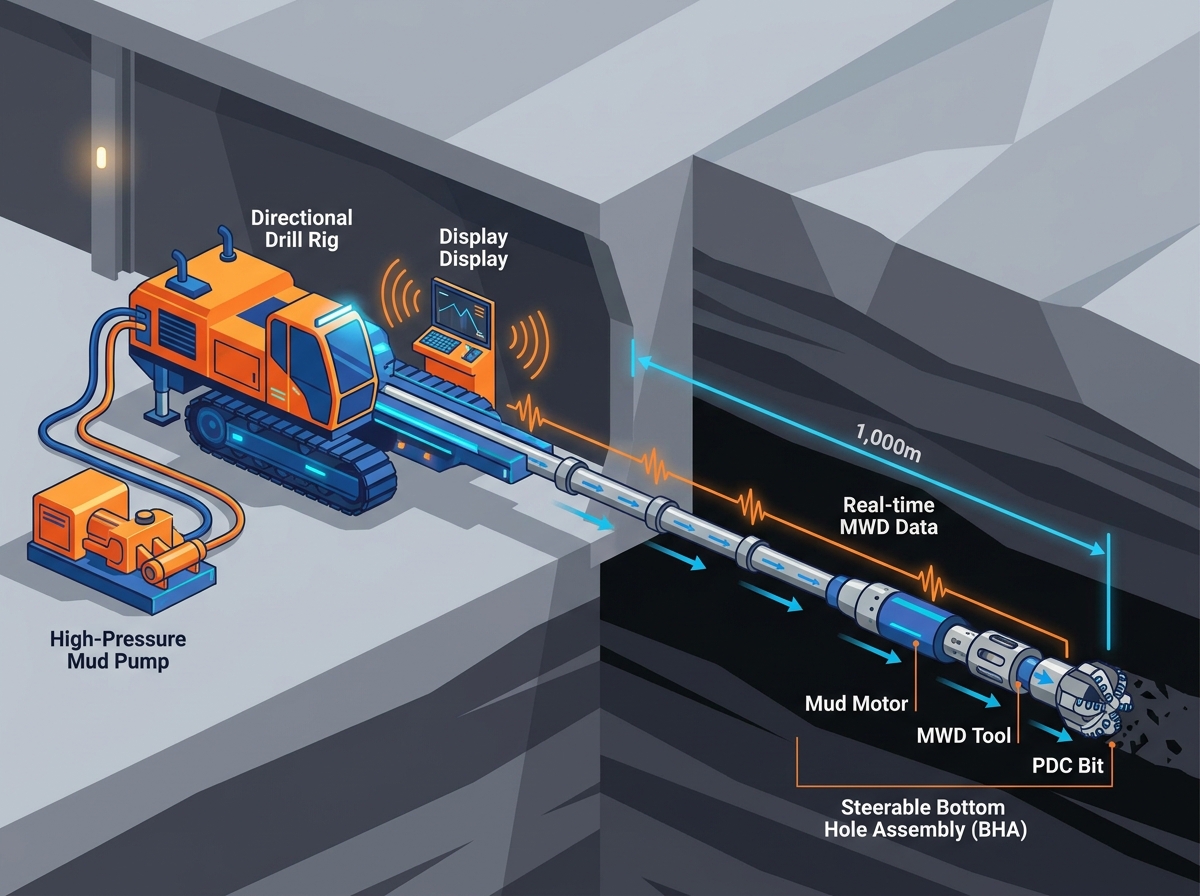
Mud pumps act as the circulatory system for your drilling operation. They power the downhole motor through immense hydraulic force. The fluid cools the cutting bit constantly during high-friction cutting. It also flushes heavy rock cuttings out over a one-kilometer horizontal distance.
Pump flow rate and pressure consistency are critical operational parameters. They represent common points of failure in long-distance operations. If fluid pressure drops, cuttings settle immediately. The pipe gets stuck in the hole. You need triplex piston pumps capable of sustaining high volumes against immense backpressure. Pulsation dampeners are also necessary to smooth out the hydraulic flow and protect downhole tools from destructive pressure spikes.
Steerable mud motors convert hydraulic fluid power into mechanical rotation right at the bit. This localized rotation is a crucial capability. It allows operators to perform slide drilling. You can correct the trajectory without rotating the entire 1,000-meter drill string. The motor features a bent housing. This bend pushes the bit in a specific direction when the string remains stationary.
Selecting the right drill bit prevents premature downhole failure. You must match PDC (Polycrystalline Diamond Compact) bits precisely to the motor’s RPM output. You must also align the bit cutter design with the coal seam's compressive strength. A mismatched bit destroys drilling efficiency instantly. It generates excessive heat and slows penetration rates to a crawl.
Blind drilling at 1,000 meters guarantees project failure. You cannot feel or see the bit location from the rig. MWD technology provides the necessary "eyes" for your underground operation. MWD systems transmit real-time navigational data back to the operator console. You receive continuous updates on azimuth, inclination, and tool face angle. This vital data keeps your trajectory locked inside the narrow coal seam.
A complete MWD system relies on several highly precise components.
Probe tubes: These protective housings contain the sensitive directional sensors and accelerometers.
Non-magnetic drill collars: These specialized pipes isolate sensors from magnetic interference caused by the standard steel drill string.
Underground display units: These rugged screens provide intrinsically safe, real-time visual readouts for the drilling crew.
Data transmission presents a unique underground challenge. You must send delicate signals through 1,000 meters of dense rock and turbulent fluid. Most operations use mud pulse telemetry. The MWD tool creates precise pressure waves in the drilling fluid column. Surface sensors decode these pulses. Sometimes, electromagnetic transmission is utilized. However, reliability limits often cap electromagnetic signals before the 1km mark in highly conductive geologies. Mud pulse remains the industry standard for deep in-seam tracking.
Procuring reliable long-distance directional drilling rigs requires careful technical auditing. You cannot base major procurement decisions on surface-level specifications. You must dig into the engineering tolerances.
First, examine the core performance specifications. You must determine the minimum continuous torque requirements for your specific mine geology. Pullback capacity is equally vital. If the hole collapses at 900 meters, you need enough raw pulling force to retrieve the entire drill string safely. A rig lacking sufficient pullback will leave expensive MWD tools buried forever.
Safety and compliance represent absolute non-negotiable factors. The equipment must adhere strictly to underground coal mine regulations. Look for internationally recognized explosion-proof electrical certifications. Ensure the hydraulic system utilizes certified fire-resistant hydraulic fluids. Strict regulatory compliance protects your crew and prevents catastrophic mine incidents.
Next, assess the physical footprint of the equipment. Compare the rig dimensions against your typical mine roadway constraints. An incredibly powerful machine fails entirely if it cannot navigate tight mine intersections. Maneuverability dictates setup speed and overall operational flexibility. Evaluate the tramming speed and the rig's turning radius.
Finally, evaluate vendor support and local parts availability. Long-distance drilling wears down metal consumables rapidly. Localized technical support minimizes expensive downtime. Readily available spare parts should heavily weight your final procurement decision.
Rig Evaluation Criteria Summary
Evaluation Category | Key Metric / Focus Area | Impact on 1,000m Drilling |
|---|---|---|
Performance Output | Continuous Torque & Pullback Force | Prevents stuck pipe scenarios; enables safe tool retrieval during severe hole collapses. |
Safety Compliance | Explosion-Proof Electrical Certification | Ensures legal operation and protects crew safety in highly gassy coal seams. |
Physical Footprint | Rig Dimensions vs. Roadway Size | Determines actual deployment feasibility within narrow, complex mine galleries. |
Vendor Support | Local Parts & Field Service Access | Reduces operational downtime significantly when critical consumable parts fail underground. |
Many project managers mistakenly assume high-end equipment guarantees drilling success. This assumption is dangerous and costly. Machinery is only one part of the complex extended-reach equation. You must manage several critical implementation risks.
Drilling fluid management is absolutely critical. Poor fluid formulation leads directly to stuck pipes, especially beyond the 800-meter mark. The fluid must carry heavy rock cuttings horizontally against gravity. If mud viscosity drops, cuttings accumulate rapidly. The borehole then collapses around the drill string. You must engineer the drilling mud specifically for your target rock type. Use high-quality polymers and bentonite additives to maintain hole stability.
Crew expertise requirements are incredibly high for these projects. Top-tier in-seam directional drilling equipment requires specialized, highly trained operators. Your crew must know exactly how to interpret complex MWD data accurately. They must manage severe reactive torque manually during slide drilling. They must recognize subtle changes in pump pressure. An untrained crew will break advanced equipment quickly and lose the borehole.
Maintenance realities dictate strict daily schedules. You cannot skip or delay preventative maintenance. Mud pumps operate under continuous, extreme loads for days. Rotary heads endure massive vibrations. Highlight the necessity of rigorous daily inspections. Replace wear parts long before they fail downhole. Check hydraulic hoses for abrasion. Verify electrical connections. A proactive maintenance culture keeps the drill turning and prevents catastrophic mid-hole failures.
Executing a 1,000m in-seam drilling operation requires a deeply integrated system. It is never just a single, standalone machine. The crawler rig, high-pressure pump, steerable motor, and MWD system must work in perfect mechanical harmony. A sudden failure in any single component halts the entire underground project immediately. Success requires matching high-performance specifications with flawless execution.
To move forward effectively, we advise starting with a comprehensive geological audit. Gather your specific seam data and carefully measure your underground space constraints. Complete this crucial step before ever requesting vendor quotes. When evaluating manufacturers, always request specific pilot case studies. Ask for data demonstrating successful 1,000m boreholes in similar coal seam conditions. Ensure you secure strong vendor support agreements. Proper planning ensures you deploy the right tools for the complex job ahead. Equip your teams with the best technology and rigorous training to conquer extended-reach challenges safely.
A: A 1,000m borehole typically requires a rig outputting between 4,000 to 6,000 N·m of continuous torque. However, this is just a technical baseline. Your specific geology strictly dictates the exact requirements. Highly fractured seams or harder coal deposits will demand significantly higher torque reserves to overcome sudden friction spikes and compounding drag.
A: MWD predominantly uses mud-pulse telemetry in coal mining environments. The downhole tool generates specific pressure waves within the drilling fluid column. These pulses travel up the fluid to surface sensors. The sensors decode the data into real-time trajectory readings. Some operations may also utilize wired pipe technology for faster transmission rates.
A: No. Standard pipes fail under the extreme bending stresses and immense torque loads of extended directional paths. You need high-strength, flexible directional drill pipes engineered for high-fatigue cycles. Additionally, non-magnetic drill collars are strictly required near the bit to prevent interference with the sensitive MWD navigational sensors.
A: The most common failure is borehole collapse due to poor drilling fluid management. Inadequate pump pressure also causes cuttings to settle, leading quickly to stuck pipes. Finally, a loss of directional control occurs if MWD signals fail or if the mud motor stalls, pulling the entire drill string out of the target seam.