+86-15829664021
liangma0318@gmail.com
- All
- Product Name
- Product Keyword
- Product Model
- Product Summary
- Product Description
- Multi Field Search


Views: 0 Author: Site Editor Publish Time: 2026-08-11 Origin: Site
Choosing the wrong data transmission method leads to catastrophic downhole signal loss. It frequently causes blind drilling operations. It drives up costly Non-Productive Time (NPT) on the rig rapidly. Operators face massive financial stakes when selecting their telemetry equipment. Modern drilling demands high-density downhole data continuously. You need this real-time data for accurate geosteering. It ensures tight operational safety margins across complex profiles. Precise wellbore placement becomes pure guesswork without it.
Telemetry technology has advanced significantly across the entire industry. However, you must carefully align your chosen equipment to the wellbore. The correct choice depends entirely on formation resistivity, drilling fluid, depth, and project budget. You will typically evaluate mud-pulse, electromagnetic, and wired pipe setups. The right setup secures your well path and protects project economics. We will explore how to match these specific transmission systems to your precise underground realities.
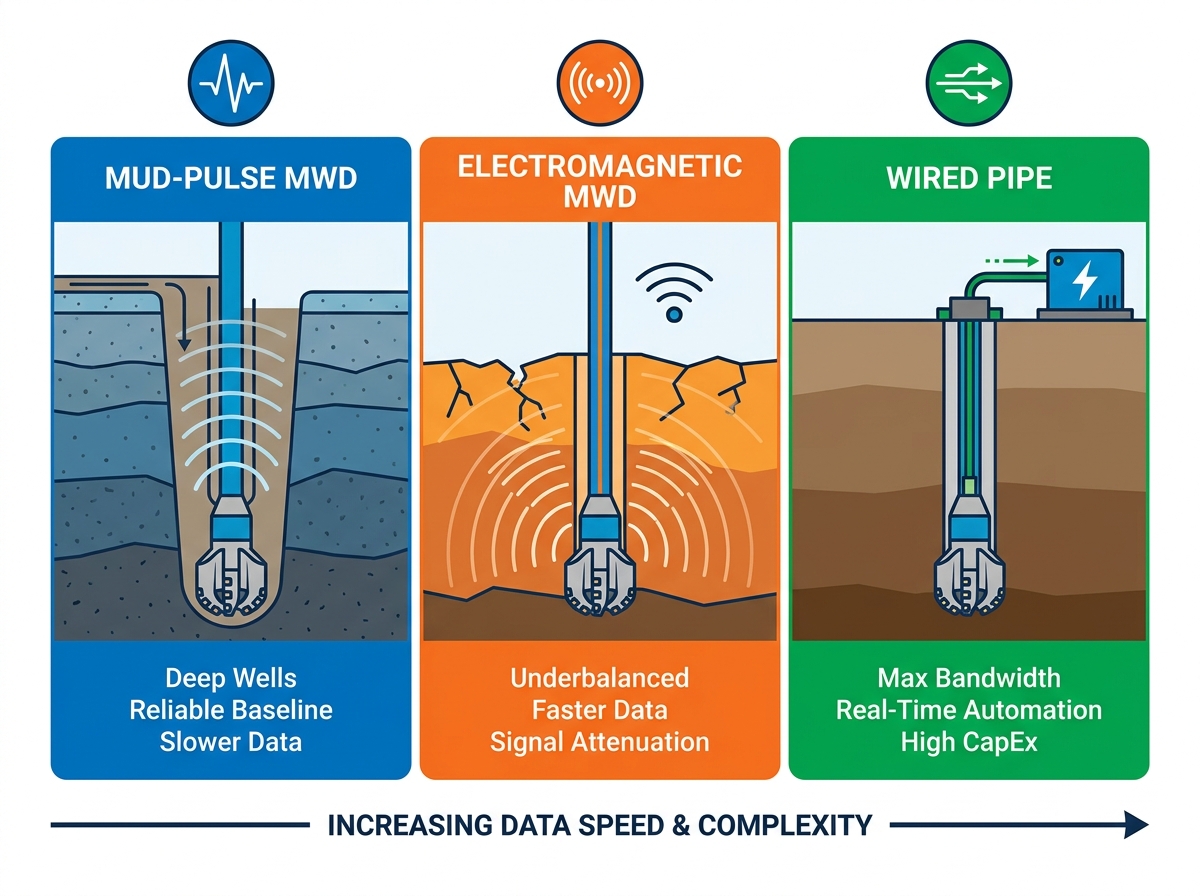
Mud-pulse telemetry remains the most reliable baseline for deep, conventional wells but struggles with compressible fluids and low transmission speeds.
Electromagnetic (EM) MWD provides faster data rates and works well in underbalanced drilling, but signal attenuation limits its use in highly conductive formations.
Wired pipe delivers unparalleled data bandwidth suitable for complex automation, but carries high upfront CapEx and requires rigorous pipe-handling protocols.
The final telemetry decision must weigh required bits-per-second (bps) against formation constraints and rig crew experience.
We evaluate measurement while drilling systems beyond their basic technical specifications. You must frame the evaluation around pure operational risk management. Equipment failure stops your drilling progress immediately. Tool rentals and rig rates drain project budgets quickly. You need telemetry choices focused on minimizing rig downtime. Daily operational teams focus heavily on keeping the drill bit turning. Signal loss forces the crew to trip the pipe out of the hole. This process wastes valuable time and inflates your daily operational spend.
Your specific data density requirements heavily influence the final telemetry selection. Basic directional surveys only need low transmission speeds. Low bits-per-second (bps) work fine for simple wellbore trajectories. Conversely, advanced Logging While Drilling (LWD) requires continuous, heavy data packages. Rotary Steerable Systems (RSS) demand high-speed inputs to adjust steering pads. They need massive data streams for exact wellbore placement. Basic pulse setups fail when running complex LWD strings. You must match the bandwidth to the bottom hole assembly (BHA) complexity.
Geological realities immediately disqualify certain telemetry methods. The drilling parameters you choose dictate tool viability underground. You must match the physics to the operating environment.
Air or foam drilling environments absorb fluid pressure pulses completely.
Oil-based muds heavily resist electrical conductivity required by certain tools.
Thick salt domes block specific electromagnetic frequency waves easily.
Highly resistive anhydrite layers alter transmission ranges unexpectedly.
You face a strict trade-off between high-tech telemetry and downhole failure realities. Downhole environments generate extreme vibration and severe stick-slip shock. High temperatures destroy complex electronic boards rapidly. Mean Time Between Failures (MTBF) matters deeply to your project success. Simple tools often outlast complex electronic assemblies underground.
Best Practices: Always review historical MTBF data from your specific service provider before signing contracts. Verify their tool performance in similar offset wells.
Common Mistakes: Ignoring anticipated shock levels leads to early tool failure. Running sensitive electronics in abrasive, high-vibration rock usually results in blind drilling.
Engineers widely consider mud-pulse MWD systems the reliable baseline industry standard. They excel in deep, conventional wellbores worldwide. These tools thrive in highly conductive formations where other tools fail. Water-based muds carry their pressure waves perfectly to the surface. They offer proven reliability across decades of rigorous field use. We trust them deeply for standard directional drilling applications. Their simplicity makes them the backbone of conventional oil and gas drilling.
You must accept strict physical limitations regarding data transmission speed. Positive and negative pulsing typically yields 0.5 to 3.0 bps. This slow data rate significantly impacts your Rate of Penetration (ROP). Signal decoding delays force the rig crew to slow down. High ROP can easily outrun the surface survey transmission. Survey time delays often accumulate over long drilling intervals. This waiting time adds up to significant rig hours over a full well.
Mud-pulse tools face distinct downhole vulnerabilities during operation. Surface pump noise heavily interferes with surface signal decoding. Fluid compressibility creates massive signal attenuation issues deep underground. Heavily aerated muds absorb pressure pulses completely before they reach the rig. Mechanical wear on the pulser assembly remains inevitable. Abrasive drilling fluids cause severe washouts on the poppet valve. When the valve washes out, pulse amplitude drops to zero.
We recommend mud-pulse setups for deep vertical or mildly deviated wells. Choose them when reliability supersedes high-definition imaging needs. They offer excellent performance at extreme depths safely.
Best Practices: Install high-quality surface pressure transducers to improve signal detection. Calibrate your pulsation dampeners to reduce background pump noise.
Common Mistakes: Running high sand content in your drilling mud accelerates pulser wear rapidly. Failing to monitor fluid weight degrades pulse quality mid-well.
Operators deploy electromagnetic MWD instruments when fluid properties eliminate mud-pulse options entirely. They serve as the clear go-to choice for underbalanced drilling. Air and gas drilling operations rely almost entirely on them. They perform perfectly when fluid circulation is lost completely. EM tools transmit data right through the earth's crust. They utilize low-frequency electromagnetic waves to reach surface antennas directly. This bypasses the fluid column entirely.
These instruments deliver significant data speed advantages over conventional pulsing. They provide faster transmission rates, routinely hitting 10+ bps. They operate entirely independently of fluid hydraulics and pump pressure. The tool design lacks moving mechanical parts inside the flow path. This internal simplicity significantly reduces mechanical failure risks. You save valuable rig time during directional surveys. Fast surveys keep the rotary table engaged and drilling forward.
Signal attenuation acts as the absolute kryptonite for EM telemetry. Highly conductive formations absorb the electromagnetic waves heavily. Saltwater aquifers degrade surface signal strength rapidly. Extreme drilling depth completely prevents surface reception eventually. Deep wells necessitate deploying expensive repeater subs in the drill string. Repeaters complicate the BHA design and increase operational risk. Battery life also drains faster when pushing signals through resistant rock.
Recommend EM telemetry for shallower, low-resistivity formations explicitly. They fit perfectly into specific underbalanced operations. Select them when mud-pulse physics simply make drilling impossible.
Best Practices: Always run a detailed EM simulation pre-drill. You must verify signal reach based on local offset log data.
Common Mistakes: Deploying EM tools near known saltwater flows ruins data reception. Failing to space out surface antennas correctly weakens signal decoding.
Engineers view wired MWD drill rods as the ultimate premium choice. They dominate highly complex, extended-reach well projects globally. They easily support advanced closed-loop automation efforts. High-tier LWD tools require this massive data pipe to function correctly. They handle dense imaging logs and seismic data effortlessly. When precise steering defines project success, wired pipe delivers unparalleled clarity.
Wired setups offer a massive leap in downhole telemetry speed. They achieve up to 57,000 bps easily under ideal conditions. This high bandwidth allows for true bi-directional communication. You can send instant tool commands from the surface directly. Survey-time delays literally drop to zero. The rig continues drilling without pausing for slow downlink commands. This continuous movement smooths out the wellbore trajectory beautifully.
You must remain highly transparent about the steep deployment downsides. Upfront capital expenditure (CapEx) remains exceptionally high for the pipe network. The inductive coils at the tool joints are inherently fragile. The rig floor crew must handle the pipe with extreme care. Rough handling breaks the delicate telemetry link instantly. Broken links require tripping the pipe to replace damaged joint connections. This negates the speed advantages gained by the system.
We recommend wired setups only for the most complex drilling profiles. The operational return on investment must justify the massive deployment. Saved drilling time and exact wellbore placement must offset the costs. Do not use wired pipe for standard vertical wells.
Best Practices: Train the rig floor crew extensively. They need specialized pipe-handling protocols before spudding the well.
Common Mistakes: Skipping inductive coil inspection during pipe makeup causes blind drilling events. Rushing the connections damages the wired network permanently.
You need a strict criteria-based framework to evaluate these options clearly. We structured a brief comparison matrix below to guide your initial selection process.
Telemetry Systems Feature Comparison Matrix
Telemetry Type | Primary Strengths | Major Limitations | Best Applications |
|---|---|---|---|
Mud-Pulse | Reliable at depth, fluid-driven, proven history | Slow data rate, susceptible to mechanical wear | Deep wells, water-based mud, conventional paths |
Electromagnetic (EM) | Fast transmission, no fluid dependence | Severe signal attenuation in conductive rock | Underbalanced, air drilling, shallow wells |
Wired Pipe | Instant data, massive bi-directional bandwidth | High upfront CapEx, fragile joint connections | Extended-reach, automation, complex steering |
Your target depth and formation geology dictate the exact path forward. You match the physics strictly to the rock. For example, wells exceeding 10,000 feet passing through heavy salt require mud-pulse. Wells under 8,000 feet utilizing air drilling demand EM technology explicitly. Deep offshore wells running complex automation prefer wired networks. You cannot force a telemetry type into an incompatible geological environment. The physics will simply defeat the tool.
Evaluate the economic realities of your project closely. Contrast the daily rental cost of standard EM or mud-pulse equipment. Compare it directly against the capital-intensive setup of a wired pipe string. Standard tool rentals fit tighter operational budgets easily. Wired pipe demands large-scale project funding and specialized rig equipment. You must balance the cost of potential NPT against the daily rental rate. A cheap tool that fails frequently costs more than a reliable premium tool.
We see a massive growing trend toward Dual-Telemetry MWD setups today. Operators frequently combine EM and mud-pulse into one single BHA. This configuration creates an excellent insurance policy against sudden blind drilling. If fluid dynamics change unexpectedly, you switch to EM telemetry instantly. If you drill too deep for surface EM reception, you toggle back to mud-pulse. This redundancy keeps the bit turning despite changing downhole conditions.
There is no universal "best" MWD telemetry system on the market.
You must match the transmission method directly to specific geological and fluid parameters.
Evaluate data density requirements carefully against tool reliability and budget constraints.
Dual-telemetry setups offer excellent redundancy for unpredictable or transitionary formations.
We strongly advise operational teams to conduct a rigorous pre-drill telemetry modeling analysis. Run EM signal strength simulations or detailed hydraulic modeling with your service providers. Complete this analysis long before signing equipment contracts or spudding the well. Proper planning prevents catastrophic data loss.
A: Yes, you can do this through dual-telemetry systems. These advanced BHAs automatically toggle transmission methods. You can also run both simultaneously. If signal attenuation increases or fluid dynamics change abruptly, the system adapts. It ensures continuous data flow without tripping out of the hole.
A: Drilling fluid dictates telemetry physics. Oil-based muds (OBM) heavily insulate EM signals, requiring specific dipole setups to function. Conversely, aerated fluids and foams absorb mud-pulse pressure waves entirely. This absorption renders conventional mud-pulse systems completely ineffective in underbalanced scenarios.
A: Generally, no. The high upfront cost and specialized handling time are rarely justified for conventional wells. You only justify wired pipe in highly complex, extended-reach profiles. In those extreme cases, massive instant data transfer prevents catastrophic wellbore placement failures. It also unlocks significant ROP gains.
A: The most common failure point is mechanical wear on the poppet and orifice. Abrasive drilling fluids blast through these components constantly. This friction leads to severe washouts. Once washed out, the tool suffers a complete loss of pulse amplitude, stopping data transmission.